Have you ever made a choice and later faced the results of that choice?
Maybe someone was kind to others and gained good friends. Or perhaps someone lied to a friend and lost their trust.
In both cases, the results came from their own actions. This is where the phrase “reap what you sow” comes in.
The phrase means that your actions bring results. If you do good things, you may get good results. If you do bad things, you may face bad results.
You may see this phrase in text messages, on WhatsApp, Instagram, or Snapchat.
People also use it in daily talks, quotes, and social media posts. But what does it really mean, and how should you use it?
In this guide, you will learn the meaning of “reap what you sow,” see simple chat examples, and discover how to reply when someone uses it.
What Does “Reap What You Sow” Mean in Text?
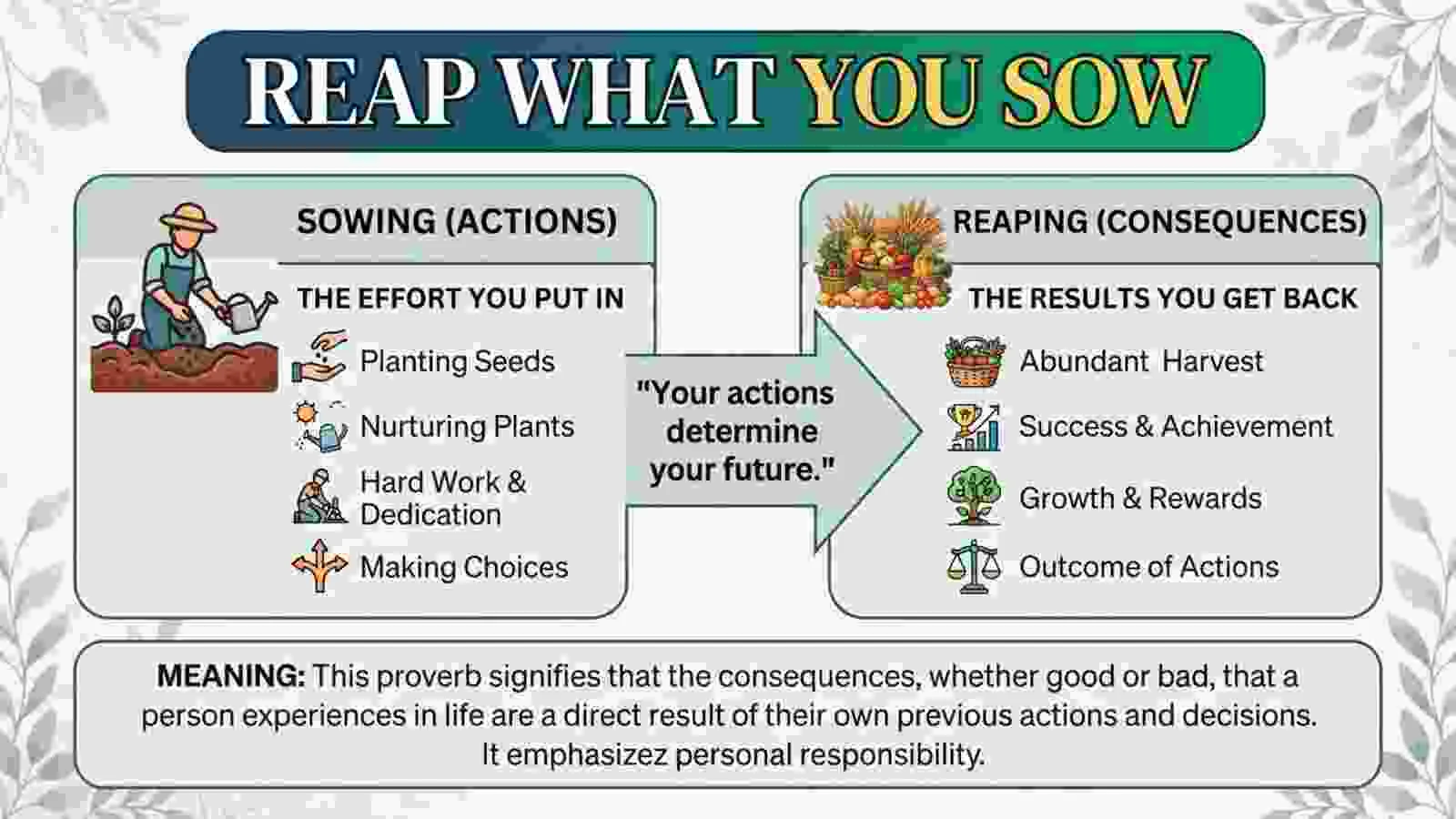
“Reap what you sow” means you face the results of your own actions. Your choices today can affect what happens to you later.
In simple words, you get back what you put into the world.
For example, if you work hard, you may reach your goals. If you treat people badly, they may stop trusting you.
Here are two simple examples:
- “He helped everyone, and now everyone helps him. You reap what you sow.”
- “She lied to her friends and lost their trust. You reap what you sow.”
The phrase can describe both good and bad results. It reminds people that their actions matter.
Full Form of “Reap What You Sow”
“Reap what you sow” has no full form. It is not an acronym or a texting abbreviation. It is a common English idiom.
The phrase comes from farming.
- Sow means to plant seeds.
- Reap means to gather the crops when they are ready.
A farmer who plants seeds may later gather the crops that grow from them. In the same way, people often face the results of their actions.
For example, if you plant seeds of kindness by helping others, you may build strong friendships. If you spread lies, you may lose people’s trust.
The phrase is also linked to a teaching in the Bible, Galatians 6:7, about a person reaping what they sow. Today, people use it in many settings, whether or not they are talking about religion.
How Is “Reap What You Sow” Used in Chat?
People use this phrase to talk about actions and their results. It may be used to give advice, explain a problem, or point out that someone’s choices have consequences.
Here are three examples.
Example 1: Friendship
Alex: “He always helped his friends when they needed him.”
Mia: “Now they are helping him. He is reaping what he sowed.”
Here, the phrase has a positive meaning. His kindness has led to support from others.
Example 2: A Broken Friendship
Sam: “She lied to everyone, and now nobody trusts her.”
Lily: “Well, you reap what you sow.”
Here, the phrase means that her actions led to the result she now faces.
Example 3: Hard Work
Noah: “I studied every day, and I passed my exam!”
Emma: “That’s great! You reap what you sow.”
Here, the phrase celebrates the reward of hard work.
What Does “Reap What You Sow” Mean From a Girl or Boy?
The meaning stays the same, no matter who says it. However, the tone may change based on the situation and the relationship between the people.
When a girl says it
A girl may use the phrase to give advice or explain why someone is facing the results of their actions.
Example:
Girl: “You ignored her when she needed help. Now she won’t help you. You reap what you sow.”
She may sound serious or upset. She may also be trying to teach someone a lesson.
When a boy says it
A boy may use it to talk about fairness, hard work, or the results of a bad choice.
Example:
Boy: “He kept breaking promises, so his friends stopped trusting him. He reaped what he sowed.”
He is pointing out the link between the person’s actions and the result.
Can it be flirty?
The phrase is not usually flirty by itself. It is more often used to talk about actions and consequences.
However, someone may use it playfully when teasing a partner or friend.
To understand the person’s true tone, look at the full message and the situation.
Is “Reap What You Sow” Rude or Polite?
The phrase is not rude by itself. It can be used to give advice, praise someone, or explain why something happened.
However, it may sound harsh when someone uses it to blame another person during a difficult time.
Polite example:
“You have worked hard for this. You are now reaping what you sowed.”
This sounds positive and supportive.
Harsh example:
“You lost all your friends because you treated them badly. You reap what you sow.”
This may sound judgmental because it points out someone’s mistakes.
If you want to use the phrase kindly, focus on the lesson rather than trying to shame the other person.
When Should You Use “Reap What You Sow”?
You can use this phrase when talking about actions and their results.
- When someone gets a good result after working hard.
- When kindness leads to stronger friendships.
- When someone’s poor choices cause problems.
- When giving advice about personal choices.
- When sharing a lesson about honesty or fairness.
- When writing a thoughtful social media caption.
Example: “Keep working hard and treating people well. You reap what you sow.”
Remember that good actions do not always lead to instant rewards. The phrase describes a general idea, not a promise that life will always be fair.
When Should You NOT Use “Reap What You Sow”?
Although the phrase is useful, it does not fit every situation.
- Do not use it to blame someone who is already in pain.
- Avoid using it to mock someone after a loss or failure.
- Do not assume every bad event is caused by a person’s actions.
- Avoid using it to judge someone without knowing the full story.
- Be careful when speaking to someone who needs comfort or support.
For example, telling a grieving friend “You reap what you sow” would likely sound cruel and uncaring.
In serious situations, kind and clear words are often better.
Best Replies to “Reap What You Sow”
Your reply depends on how the person uses the phrase. Here are five simple responses.
- “That’s true. Our actions matter.” — A thoughtful reply.
- “I agree. We should treat people well.” — A positive response.
- “Sometimes, our choices teach us hard lessons.” — A reflective response.
- “I understand. I’ll try to make better choices.” — A response when you accept the lesson.
- “I see your point, but not every situation is that simple.” — A calm reply when you disagree.
You do not have to agree with the phrase every time someone uses it. Sometimes, people face problems through no fault of their own.
“Reap What You Sow” Meaning on WhatsApp, Instagram, and Snapchat
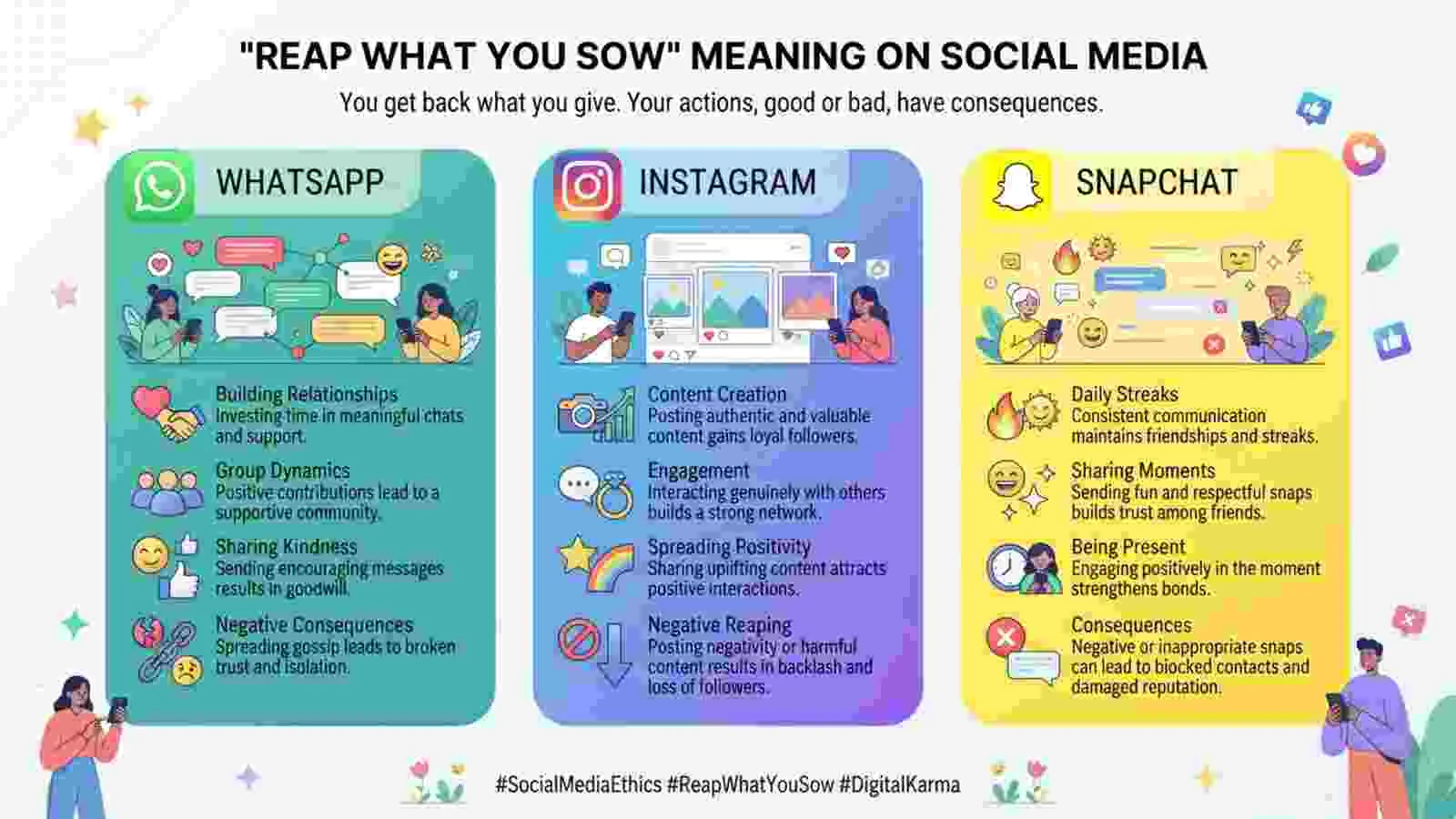
The basic meaning stays the same across these platforms. It refers to the results of your actions.
On WhatsApp
People may use the phrase in private chats or group messages to give advice or talk about a life lesson.
Example: “You helped everyone, and now they are here for you. You reap what you sow.”
On Instagram
The phrase may appear in captions, quotes, reels, or comments about success, kindness, and consequences.
Example caption: “Choose kindness every day. You reap what you sow.”
On Snapchat
Friends may use it in a chat when discussing a choice or its result.
Example: “You kept skipping practice, so you struggled in the game. You reap what you sow.”
The phrase is not platform-specific slang. It is a common English idiom that people use online and offline.
Similar Slang Words and Phrases Like “Reap What You Sow”
Here are five related phrases that express similar ideas.
- Actions have consequences: What you do can lead to results, good or bad.
- Karma: The idea that your actions may bring similar results back to you.
- What goes around comes around: The way you treat others may come back to affect you.
- You get what you give: The effort or treatment you offer may shape what you receive.
- You made your bed, now lie in it: You must accept the results of your own choices.
These phrases are similar, but they are not exactly the same. “Reap what you sow” focuses on the results of actions over time. “You made your bed, now lie in it” is more direct and often sounds critical.
FAQs About “Reap What You Sow”
1. Is “reap what you sow” positive or negative?
It can be both. It may describe good results from good actions or bad results from harmful choices.
2. Is “reap what you sow” slang?
No. It is a common English idiom. People use it in conversations, social media posts, books, and everyday life.
3. Is it safe to use with elders?
Yes. It is a normal English phrase. However, it can sound disrespectful if you use it to blame or criticize an older person. Use a kind tone.
4. Is “reap what you sow” common in daily chat?
Yes. People use it when talking about choices, hard work, friendships, and consequences. It may sound more thoughtful or formal than everyday slang.
5. Does “reap what you sow” mean karma?
The meanings are closely related. Both connect actions with results. However, karma has deeper meanings in several religious and philosophical traditions.
6. Can “reap what you sow” be used in a positive way?
Yes. For example, “You worked hard and stayed focused. Now you are reaping what you sowed.” This praises someone’s effort.
7. What is another way to say “reap what you sow”?
You can say “actions have consequences,” “what goes around comes around,” or “you get what you give.”
Conclusion
“Reap what you sow” means that you often face the results of your own actions. Good choices may lead to good results, while harmful choices may cause problems later.
People use this phrase in daily conversations, text messages, and social media posts. It can offer advice, praise hard work, or explain why someone is facing the results of a choice.
The phrase is not always positive or negative. Its tone depends on the situation and the way it is used.
Now you know what “reap what you sow” means and how to use it in the right context. Remember to use it with care, especially when someone is going through a hard time.
Keep learning common English idioms and phrases to make your conversations clearer and more natural.
Continue Reading:
- Apple of My Eye Meaning: Definition, Origin, and Examples ( for 2026)
- La Vie en Rose Meaning: Translation, Origin, and Symbolism ( for 2026)
- Chip on Your Shoulder Meaning: Definition, Origin, and Examples ( for 2026)

William Bennett is a dedicated writer and language enthusiast who shares clear, helpful insights on word meanings, spelling, grammar, and everyday English.
As an author at MeaningZones.com, he aims to make confusing language topics simple, practical, and easy for readers to understand.