Have you ever heard someone say, “Bless your heart,” and wondered what they really meant?
Maybe a friend sent it in a text, or you saw it in an Instagram comment. At first, it may sound kind and sweet. But sometimes, the phrase can have a hidden meaning.
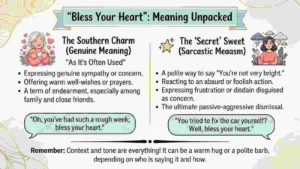
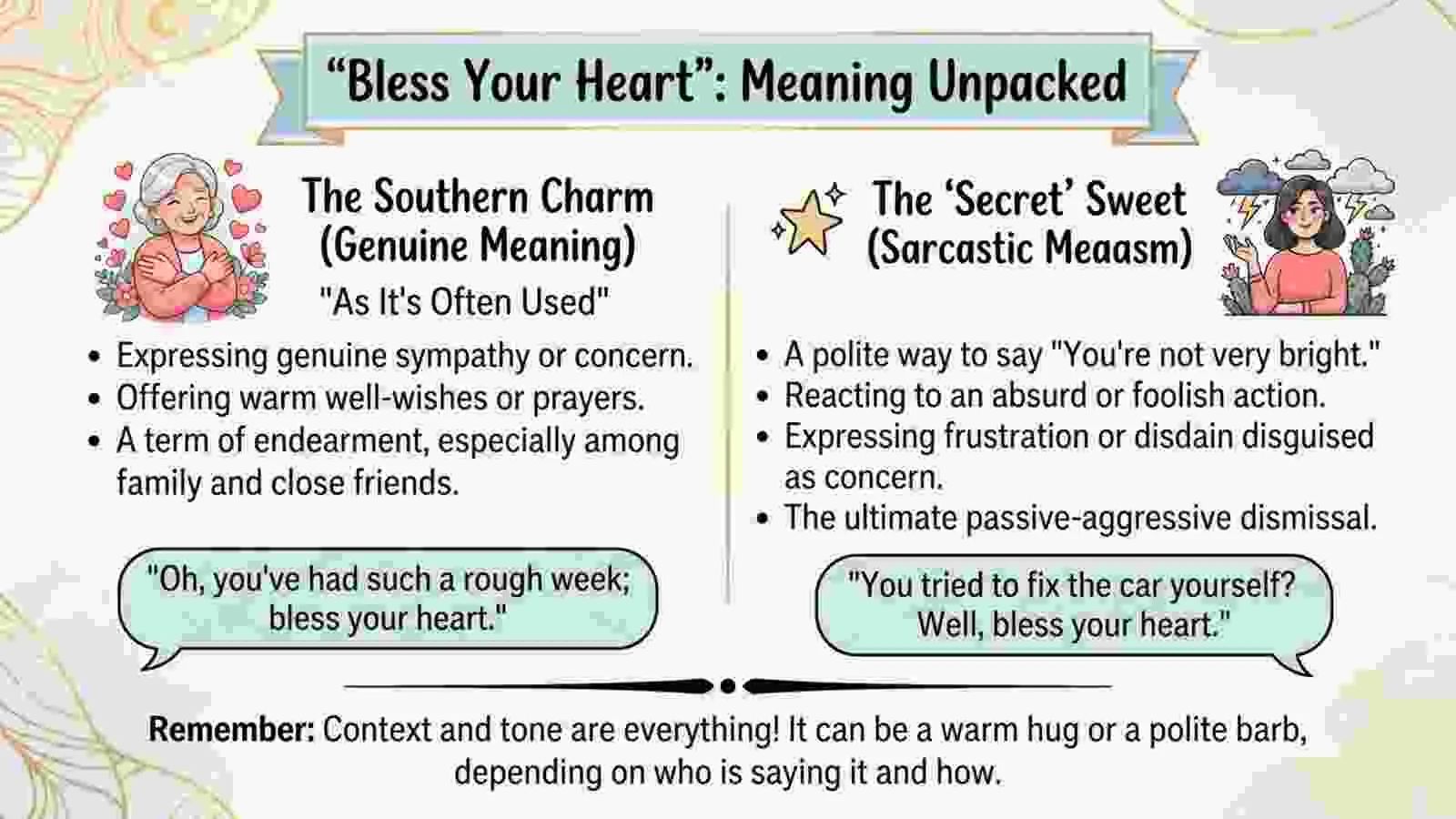
“Bless your heart” can show kindness, care, sympathy, or even mild sarcasm. The meaning depends on the speaker, the situation, and their tone.
This phrase is often linked to Southern American English. People use it in daily talks, family chats, and online messages. You may also see it on WhatsApp, Instagram, and Snapchat.
In this guide, you will learn the meaning of “bless your heart,” how people use it, and how to reply. You will also learn when it sounds kind and when it may feel like an insult.
What Does “Bless Your Heart” Mean in Text?
“Bless your heart” is a phrase that can express care, sympathy, or gentle pity. In some situations, it can also be a polite way to criticize someone or make fun of them.
For example:
- Kind meaning: “I’m sorry you had such a hard day. Bless your heart.”
- Sympathetic meaning: “You have been working so hard. Bless your heart.”
- Sarcastic meaning: “You really thought that would work? Bless your heart.”
The phrase does not always mean the same thing. You need to look at the full message to understand it.
Full Form of “Bless Your Heart”
“Bless your heart” does not have a full form. It is not an acronym or an abbreviation. It is a common English expression.
The word “bless” can express a wish for goodness or care. “Your heart” refers to the person and their feelings.
Together, the phrase can show warmth, concern, or sympathy. However, people may also use it in a sarcastic way.
How Is “Bless Your Heart” Used in Chat?
People use this phrase in different ways. Here are three examples.
Example 1: Showing kindness
Mia: “I stayed up all night caring for my sick cat.”
Lily: “Oh, bless your heart. I hope your cat feels better soon.”
Here, Lily shows care and sympathy.
Example 2: Offering comfort
Alex: “I worked all week, but my plans got canceled.”
Sam: “Bless your heart. You must be so tired.”
Sam uses the phrase to show understanding.
Example 3: Being sarcastic
Jake: “I can fix the computer by hitting it.”
Emma: “Bless your heart. Maybe let’s try something else.”
Emma may be gently teasing Jake about his idea.
These examples show why context matters. The same phrase can sound warm or sarcastic.
What Does “Bless Your Heart” Mean From a Girl or Boy?
The meaning depends on the person and the situation, not just their gender.
When a girl says “Bless Your Heart”
A girl may use it to show care, sympathy, or affection.
Example:
Girl: “You helped everyone today. Bless your heart!”
This sounds warm and thankful.
But if she says it after someone makes a silly mistake, she may be teasing them or showing mild annoyance.
When a boy says “Bless Your Heart”
A boy may use it to comfort someone or show kindness.
Example:
Boy: “You had a rough day. Bless your heart. Want to talk?”
This sounds caring and supportive.
In another situation, he might use the phrase to joke about someone’s mistake.
Is it flirty?
The phrase is not usually flirty on its own. It may sound affectionate when used by someone who likes you, but it does not prove romantic interest.
Look at the full conversation and the person’s behavior before deciding what they mean.
Is “Bless Your Heart” Rude or Polite?
“Bless your heart” can be polite, kind, or sarcastic. Its tone depends on how and why someone says it.
When it is polite:
Someone may use it to comfort a friend who is sick, tired, or upset.
Example: “You have been through so much. Bless your heart.”
When it sounds rude:
Someone may use it to suggest that another person is foolish or does not understand something.
Example: “You think that plan will work? Bless your heart.”
In this case, the phrase may sound like an insult hidden behind kind words.
How can you tell the difference?
Look at these clues:
- The person is offering help or comfort.
- Their message includes warm and caring words.
- They use the phrase after a mistake or an argument.
- Their other words sound mocking or dismissive.
Do not judge the phrase by itself. Read the full message and consider your relationship with the sender.
When Should You Use “Bless Your Heart”?
You can use this phrase in casual conversations when you want to show care or gentle humor.
- When a friend is having a hard day.
- When someone shares sad news.
- When you want to show sympathy.
- When you want to thank someone for being kind.
- When joking with a friend who understands your humor.
- When talking with someone familiar with Southern American expressions.
Example: “You have been helping everyone all day. Bless your heart!”
Use it with care if you are unsure how the other person may understand it.
When Should You NOT Use “Bless Your Heart”?
This phrase may cause confusion in some situations.
- Do not use it to mock someone who is upset.
- Avoid it when someone needs serious support.
- Do not use it to hide an insult behind kind words.
- Avoid it in formal work messages unless the tone is suitable.
- Do not assume everyone understands its Southern American meaning.
- Avoid using it during an argument if it may sound condescending.
For example, if a coworker makes a mistake, saying “Bless your heart” may sound rude. A clearer response would be, “No problem. Let’s fix it together.”
Best Replies to “Bless Your Heart”
Your reply depends on whether the person is being kind or sarcastic.
Here are five simple replies.
- “Thank you!” — Use this when the person is being kind.
- “That’s so sweet of you.” — A warm reply to a caring message.
- “I appreciate that.” — A polite response.
- “Haha, I know!” — Use this when a friend is joking with you.
- “What do you mean by that?” — Use this when you are unsure about their tone.
Example conversation
Friend: “You forgot your keys again. Bless your heart.”
You: “Haha, I really need to get organized!”
This reply works if the comment is playful.
If the message feels insulting, you can stay calm and ask for clarification instead of arguing.
“Bless Your Heart” Meaning on WhatsApp, Instagram, and Snapchat
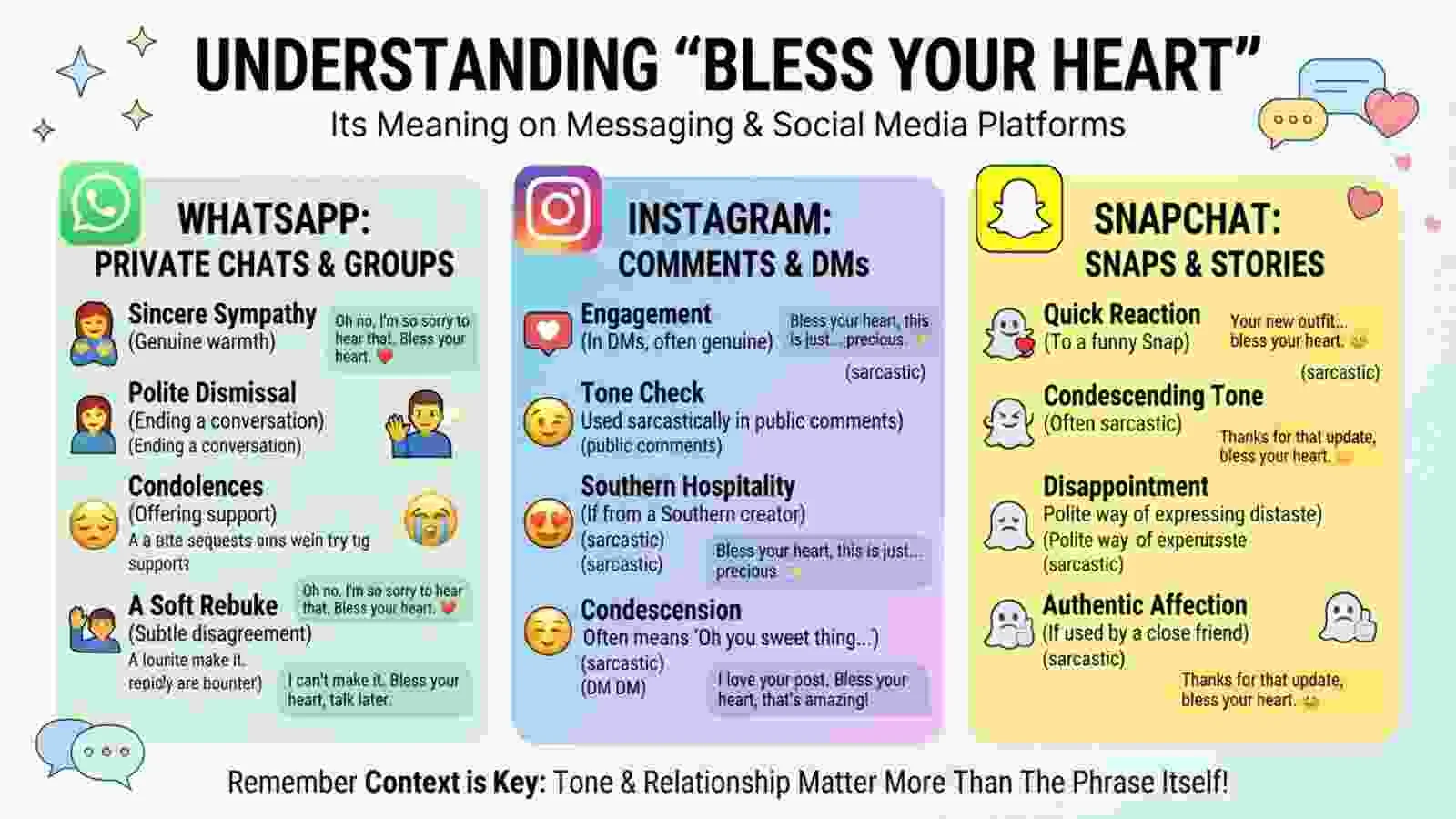
The basic meaning stays the same across these platforms. It can express kindness, sympathy, affection, or sarcasm.
On WhatsApp
People may use the phrase in private chats with friends or family.
Example: “You have been taking care of everyone. Bless your heart ❤️”
The heart emoji may make the message feel warmer, though the full context still matters.
On Instagram
The phrase may appear in comments under posts about hard times, personal stories, or funny mistakes.
Example: “You tried your best. Bless your heart!”
Depending on the post, it could be supportive or sarcastic.
On Snapchat
Friends may use it in quick messages or playful conversations.
Example: “You sent that message to the wrong person? Bless your heart 😂”
The laughing emoji suggests teasing, but the relationship between the people also matters.
The platform does not change the basic meaning. The context, tone, and emojis help show what the sender intends.
Similar Slang Words and Phrases Like “Bless Your Heart”
Here are five related expressions.
- Oh, honey: A warm phrase that can show care or gentle pity. It can also sound patronizing.
- Poor thing: Shows sympathy for someone who is having a hard time.
- Sweetie: A friendly or affectionate way to address someone. Tone can make it sound condescending.
- Good for you: Shows approval, but can sound sarcastic in some situations.
- Nice try: Recognizes an attempt, but may be sincere or teasing depending on context.
These phrases are not exact replacements for “bless your heart.” Each one has its own tone and meaning.
FAQs About “Bless Your Heart”
1. Is “bless your heart” positive or negative?
It can be either. It often shows kindness or sympathy, but it can also be sarcastic or critical.
2. Is “bless your heart” an insult?
Not always. It becomes insulting when someone uses it to mock another person or suggest they are foolish.
3. Is “bless your heart” common in daily chat?
Yes. It is used in everyday speech and online messages, especially in contexts influenced by Southern American English.
4. Is it safe to use with elders?
It can be polite when used sincerely to show care. However, avoid a sarcastic tone, as it may sound disrespectful.
5. Does “bless your heart” mean someone likes you?
Not necessarily. It may show kindness or affection, but it does not automatically mean romantic interest.
6. Why do people say “bless your heart” sarcastically?
Some people use it to criticize someone indirectly. It can sound softer than a direct insult, but the message may still be negative.
7. What is another way to say “bless your heart”?
You can say “I’m sorry you’re going through this,” “That’s so kind of you,” or “I hope things get better,” depending on what you mean.
Conclusion
“Bless your heart” is a common English phrase that can express kindness, sympathy, and care. But it can also carry a sarcastic meaning, especially in some Southern American conversations.
The key is to look at the situation, the person’s tone, and the words around the phrase. A warm message may show genuine concern, while a teasing message may carry a hidden criticism.
Now you know how to understand “bless your heart” in texts, chats, and social media posts. You can also choose a suitable reply based on the speaker’s tone.
If you enjoy learning everyday expressions, explore more slang words and idioms to understand online conversations with confidence.

Ella Peterson is an English language writer and grammar enthusiast at MeaningZones.com. She focuses on clear and practical English grammar, vocabulary, sentence structure, and everyday language usage.
Through easy-to-understand explanations and helpful examples, Ella helps readers improve their English writing and communication skills. Her goal is to make English grammar simple, useful, and accessible to everyone.