Have you ever heard someone say, “This boring meeting is for the birds”?
You may wonder what birds have to do with a meeting. Does the person love birds, or are they saying something else?
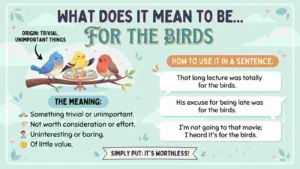
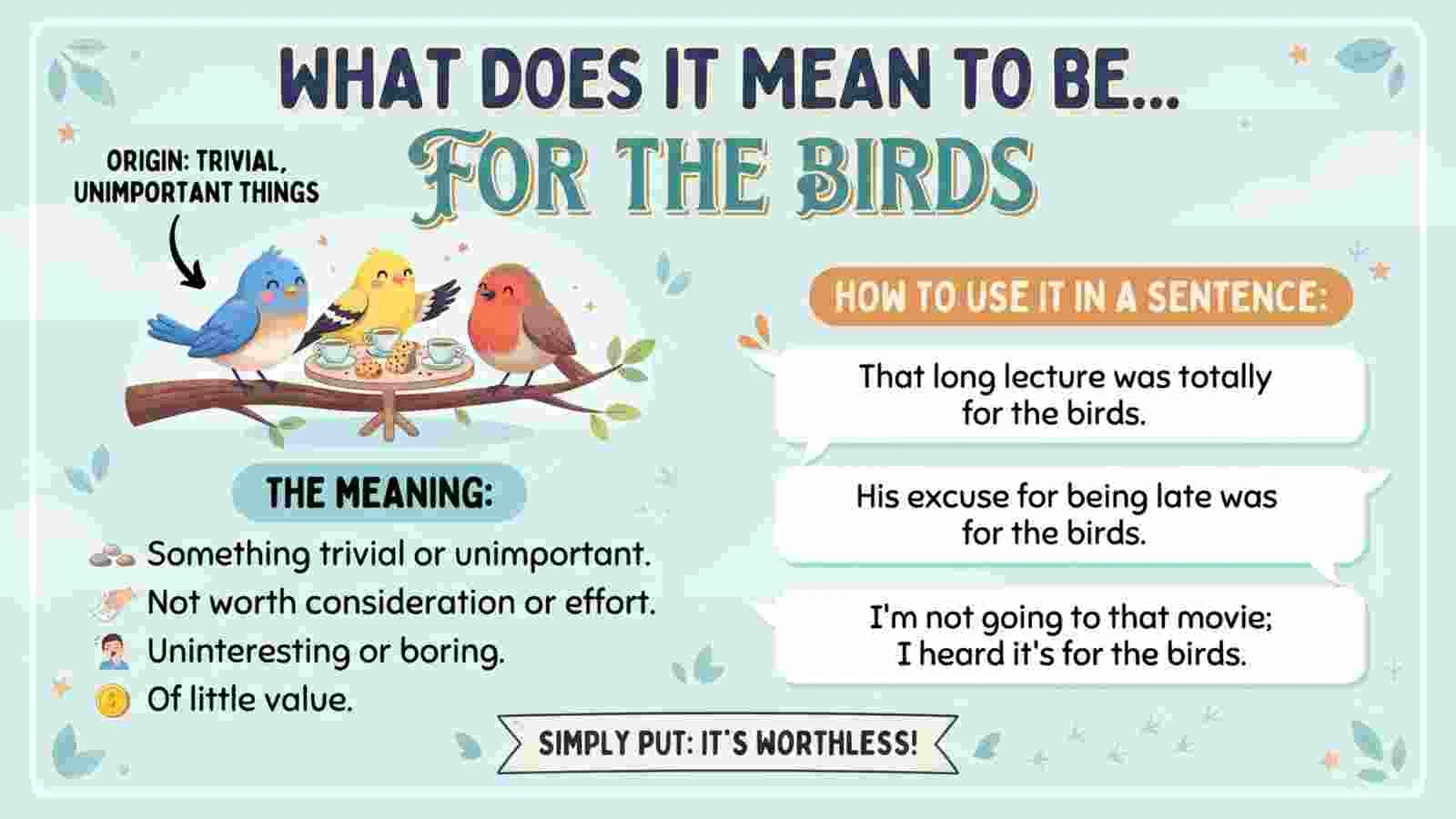
The phrase “for the birds” means something is useless, silly, boring, or not worth your time.
It is an informal English idiom. People often use it to show that they do not like something or think it has little value.
You may see this phrase in text messages, on WhatsApp, Instagram, Snapchat, or in everyday talks. It can describe a bad movie, a pointless argument, or a task that feels like a waste of time.
In this guide, you will learn the meaning of “for the birds,” how to use it, and how to reply when someone says it. You will also see simple examples to help you understand the phrase with ease.
What Does “For the Birds” Mean in Text?
“For the birds” means something is silly, useless, boring, or not worth caring about.
People use it when they dislike something or feel that it has no real value.
For example:
- “This homework is for the birds.”
- “That movie was for the birds.”
- “His excuses are for the birds.”
In each example, the speaker thinks the thing is bad, pointless, or not worth their time.
The phrase is often used in a casual way. It can sound funny, annoyed, or critical, based on the situation.
Full Form of “For the Birds”
“For the birds” has no full form. It is not an acronym or an abbreviation. It is an English idiom.
An idiom is a phrase whose meaning is different from the literal meaning of its words.
For example, “for the birds” does not usually mean that something is meant for real birds. Instead, it means that something is silly, useless, or not worth much.
Example:
Friend 1: “What did you think of the new show?”
Friend 2: “It was for the birds.”
Here, the second friend means the show was bad or not worth watching.
The phrase is most often used in informal speech and writing. It can help people share their opinions in a short and colorful way.
How Is “For the Birds” Used in Chat?
People use “for the birds” to show that they think something is boring, pointless, or poor in quality.
Here are three simple chat examples.
Example 1: Talking About School
Alex: “How was the extra class?”
Sam: “It was for the birds. We learned nothing new.”
Sam thinks the class was a waste of time.
Example 2: Talking About a Movie
Mia: “Did you like the movie?”
Noah: “Not at all. The story was for the birds.”
Noah did not enjoy the movie and thinks it was poor.
Example 3: Talking About an Argument
Lily: “Why are they fighting over such a small thing?”
Jake: “Their whole argument is for the birds.”
Jake thinks the argument is pointless.
These examples show that the phrase can describe many things. It works best when you want to express a negative opinion in a casual way.
What Does “For the Birds” Mean From a Girl or Boy?
The phrase has the same basic meaning no matter who says it. It usually shows that the person thinks something is silly, useless, or not worth their time.
However, the tone can change based on the situation.
When a Girl Says “For the Birds”
A girl may use the phrase to show that she is bored, annoyed, or unhappy with something.
Example:
Girl: “That party was for the birds.”
She means she did not enjoy the party.
She might also use it as a joke when talking with friends. The phrase does not automatically show anger or dislike toward the person she is speaking to.
When a Boy Says “For the Birds”
A boy may use it to criticize an idea, event, or activity.
Example:
Boy: “These excuses are for the birds.”
He thinks the excuses are silly or not believable.
Can It Be Flirty?
“For the birds” is not usually a flirty phrase. It is more often used to express dislike or disappointment.
Still, friends or romantic partners may use it in a playful way.
Example:
Girl: “Your idea of a fun date is watching paint dry. That’s for the birds!”
She may be teasing her partner.
Tip: Look at the full message and the person’s tone before deciding what they mean.
Is “For the Birds” Rude or Polite?
“For the birds” is informal and often negative. It is not usually a swear word, but it can sound rude because it dismisses something as useless or silly.
When It Sounds Casual
Friend: “What did you think of that game?”
You: “It was for the birds.”
This sounds like a casual opinion between friends.
When It Sounds Rude
Coworker: “I spent all week preparing this plan.”
You: “Your plan is for the birds.”
This may sound insulting because it dismisses the coworker’s effort.
How to Use It Politely
If you want to disagree without sounding harsh, try a softer phrase.
- “I don’t think that will work.”
- “It wasn’t very useful.”
- “I didn’t enjoy it.”
- “I think we can find a better option.”
Use “for the birds” with people who understand your tone. In formal settings, clearer and kinder words are often better.
When Should You Use “For the Birds”?
You can use this phrase in casual situations when you want to say that something is not worth your time.
- When talking about a boring movie or TV show.
- When describing a pointless argument.
- When discussing a task that feels useless.
- When joking with close friends.
- When sharing a negative opinion about an idea.
- When talking about an event you did not enjoy.
Example: “Waiting three hours for a five-minute show was for the birds.”
The phrase works well in everyday chats, but remember that it expresses a negative view.
When Should You NOT Use “For the Birds”?
This phrase may not be suitable for every situation.
- Avoid it in formal emails and business reports.
- Do not use it to insult someone’s hard work.
- Avoid it when discussing a sensitive personal issue.
- Do not use it with someone who may not understand English idioms.
- Avoid it when you need to give clear and respectful feedback.
For example, telling a teacher that their lesson is “for the birds” may sound disrespectful.
Instead, you could say, “I found the lesson difficult to follow. Could you explain it another way?”
Choose your words based on your audience and the situation.
Best Replies to “For the Birds”
If someone uses this phrase, your reply depends on what they are talking about.
Here are five simple responses.
- “Really? Why do you think so?” — Use this when you want to know their reason.
- “I agree. It wasn’t very useful.” — Use this when you share their opinion.
- “I actually liked it!” — Use this when you have a different view.
- “Haha, it was pretty boring.” — Use this in a casual chat.
- “Maybe we can find a better option.” — Use this when discussing a plan or idea.
Example Conversation
Friend: “That new game is for the birds.”
You: “Really? I thought it looked fun.”
This keeps the conversation friendly, even when you disagree.
You do not need to agree with someone just because they use the phrase. You can share your own view in a calm and respectful way.
“For the Birds” Meaning on WhatsApp, Instagram, and Snapchat
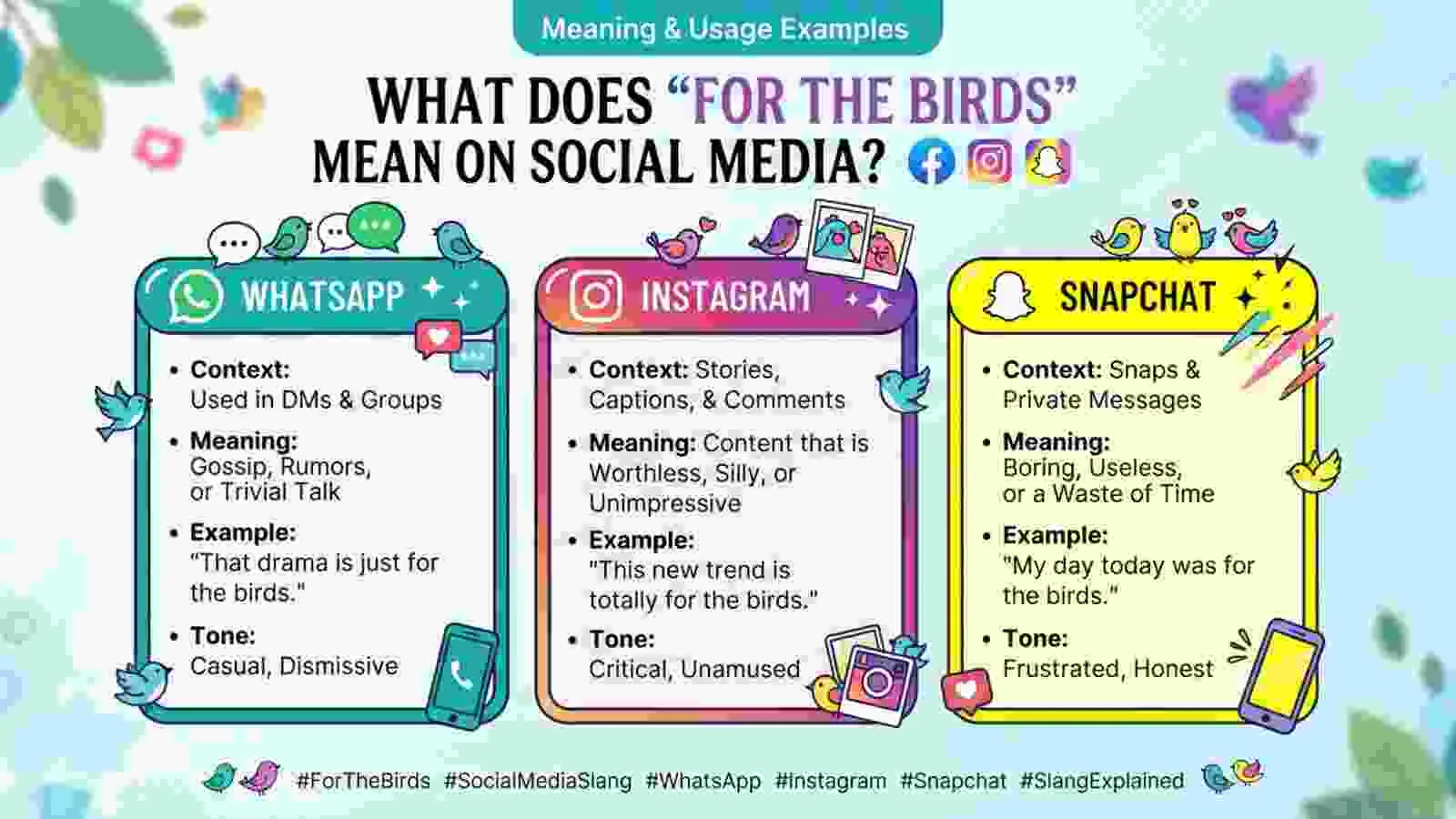
The meaning of “for the birds” usually stays the same across social media platforms. It means something is silly, useless, boring, or not worth the effort.
On WhatsApp
Friends may use it in private chats or group messages.
Example:
“Today’s meeting was for the birds. We talked for two hours and solved nothing.”
The sender thinks the meeting was pointless.
On Instagram
Someone may use the phrase in a comment or direct message to express a negative opinion about a show, trend, or event.
Example:
“That trend is for the birds. I don’t understand the hype.”
The person thinks the trend is not worth the attention it gets.
On Snapchat
Friends may use it when talking about plans, school, or daily life.
Example:
“Waiting in that long line was for the birds!”
The person thinks the wait was a waste of time.
The phrase is not unique to any one app. It is a common English idiom that people can use both online and in face-to-face conversations.
Similar Slang Words and Phrases Like “For the Birds”
Here are five related expressions that can help you share a similar idea.
- A waste of time: Something that takes time but gives little or no value.
- Pointless: Something that has no clear purpose or benefit.
- unimpressive: Informal slang for something boring, weak, or unimpressive.
- Nonsense: Words or ideas that seem silly, unreasonable, or untrue.
- Not worth it: Something that does not give enough value to justify the time, cost, or effort.
These phrases have similar meanings, but they are not always interchangeable.
For example, “a waste of time” focuses on lost time, while “nonsense” often describes an idea or statement that seems unreasonable.
“For the birds” is a colorful, informal way to say that you think something is not worth much.
FAQs About “For the Birds”
1. Is “for the birds” positive or negative?
It is usually negative. It means something is silly, useless, boring, or not worth your time.
2. Is “for the birds” slang?
It is more accurately described as an informal English idiom. People use it in casual speech and writing to express a negative opinion.
3. Is it safe to use with elders?
You can use it, but be careful with your tone. Some people may find it disrespectful if you use it to criticize their ideas or efforts.
4. Is “for the birds” common in daily chat?
Yes, especially among people who know the expression. However, it may be less familiar to some English learners or people who do not use this idiom often.
5. Does “for the birds” mean something is useless?
Yes. It often means something is useless, pointless, silly, or not worth the effort.
6. Can I use “for the birds” at work?
It is best to avoid it in formal work messages because it can sound dismissive. Use phrases such as “not useful” or “unlikely to work” instead.
7. Where did the phrase “for the birds” come from?
The phrase became popular in American English during the 20th century. One common explanation links it to the idea that birds pick at small scraps or seeds that people may see as having little value. Its exact origin is not fully certain.
Conclusion
“For the birds” is a common English idiom that means something is silly, useless, boring, or not worth your time. People often use it when they dislike an idea, event, movie, or activity.
You may see it in text messages, on WhatsApp, Instagram, Snapchat, or in everyday talks. Its meaning usually stays the same across these settings, but the tone can be playful, annoyed, or critical.
Now you know how to understand and use the phrase. You can use it with friends when sharing a casual opinion, but choose softer words in formal or sensitive situations.
Keep learning common English idioms and slang phrases to make your conversations clearer and more natural.

William Bennett is a dedicated writer and language enthusiast who shares clear, helpful insights on word meanings, spelling, grammar, and everyday English.
As an author at MeaningZones.com, he aims to make confusing language topics simple, practical, and easy for readers to understand.