Have you ever met someone who gets upset over small things?
Maybe they think others are against them. Or perhaps they always try to prove that they are better than everyone else.
Someone might say, “He has a chip on his shoulder.” But what does this phrase mean?
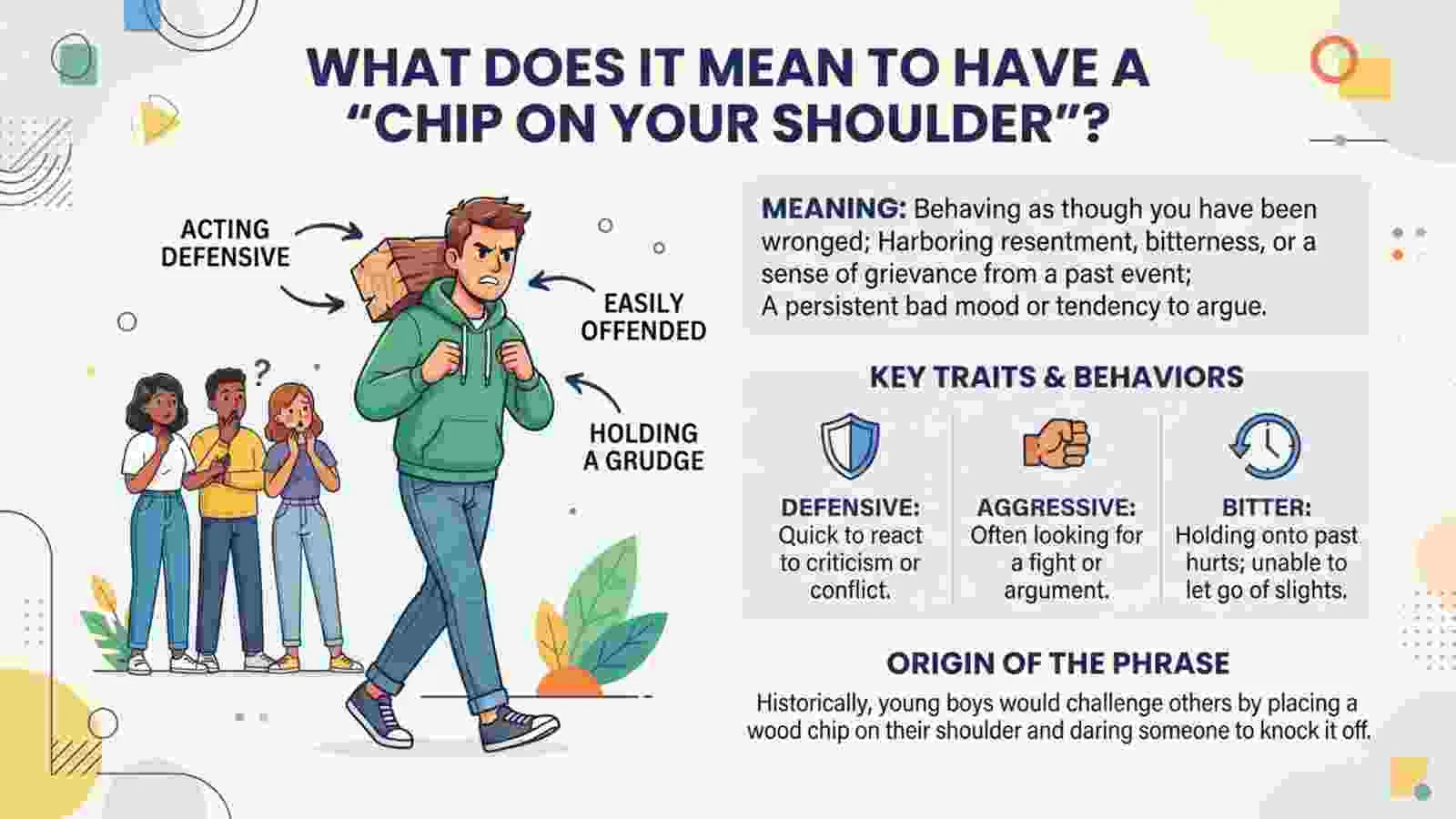
“Chip on your shoulder” means feeling angry, upset, or bitter because you think someone has treated you unfairly.
It can also describe a person who acts as if they need to prove themselves to others.
You may see this phrase in text messages, online comments, or daily talks. People may use it on WhatsApp, Instagram, and Snapchat when talking about someone’s attitude.
In this guide, you will learn the meaning of “chip on your shoulder,” see simple chat examples, and discover how to use it correctly. You will also learn whether it sounds rude and how to reply when someone uses it.
What Does “Chip on Your Shoulder” Mean in Text?
“Chip on your shoulder” means that someone feels angry or bitter about a past insult, unfair treatment, or personal problem. This feeling may cause them to become defensive or try to prove themselves.
In simple words, it describes someone who carries old anger and takes things personally.
For example:
- “He has a chip on his shoulder because his team did not choose him.”
- “She acts like everyone is against her. She has a chip on her shoulder.”
- “Don’t take his words too seriously. He has a chip on his shoulder.”
The phrase does not mean that someone has a real chip on their shoulder. It is an idiom with a figurative meaning.
It can describe a person who feels they have something to prove. It can also describe someone who still feels hurt by something that happened in the past.
Full Form of “Chip on Your Shoulder”
“Chip on your shoulder” has no full form. It is not an acronym or an abbreviation. It is a common English idiom.
The phrase is linked to an old practice in which a person placed a chip of wood on their shoulder and dared another person to knock it off. Doing so could be seen as a challenge to fight.
Over time, the phrase came to describe a person who holds a grudge, feels insulted, or seems ready to argue.
Today, people use it in everyday conversations, books, films, social media posts, and online chats.
For example:
“Ever since he lost the match, he has had a chip on his shoulder.”
This means he still feels upset about the loss and may be acting in a defensive way.
How Is “Chip on Your Shoulder” Used in Chat?
People use this idiom when they want to describe someone’s attitude or explain why a person seems angry or defensive.
Here are three simple chat examples.
Example 1: After an argument
Alex: Why does Mark get upset whenever we talk about work?
Sam: I think he has a chip on his shoulder about getting passed over for a promotion.
Meaning: Mark may still feel hurt because he did not get the promotion.
Example 2: At school
Mia: Why does Jake always try to beat me at everything?
Lily: Maybe he has a chip on his shoulder because people used to make fun of him.
Meaning: Jake may feel that he needs to prove himself because of past experiences.
Example 3: On social media
Noah: Why is that guy arguing with everyone in the comments?
Emma: He seems to have a chip on his shoulder.
Meaning: Emma thinks the person is holding on to anger or acting defensively.
The phrase can help explain someone’s behavior. However, it is best not to use it to judge someone without knowing their side of the story.
What Does “Chip on Your Shoulder” Mean From a Girl or Boy?
The meaning stays the same whether a girl or a boy uses the phrase. The tone depends on the situation and the person speaking.
When a girl says it
A girl may use the phrase to describe someone who seems angry, defensive, or hurt by past events.
Example:
Girl: “He has a chip on his shoulder about his old relationship.”
She may mean that he still feels hurt or bitter about what happened.
If she says it about you, she may think you are taking things personally. It does not always mean she dislikes you.
When a boy says it
A boy may use the phrase when he thinks someone is holding a grudge or trying too hard to prove themselves.
Example:
Boy: “My friend has a chip on his shoulder because he lost the game.”
He means his friend is still upset about losing.
Can it be flirty?
The phrase is not normally flirty. It is more often used to describe anger, resentment, or a defensive attitude.
In a playful conversation, someone may use it as a joke. Still, the phrase can sound critical if directed at another person.
Do not assume romantic interest from this idiom alone. Look at the full conversation and the person’s tone.
Is “Chip on Your Shoulder” Rude or Polite?
The phrase is not a swear word, but it can sound rude or judgmental.
When you say someone has a chip on their shoulder, you suggest that they are carrying anger or acting defensively. The person may feel that you are criticizing their attitude.
Polite example:
“I think he may still feel hurt by what happened.”
This explains the situation without labeling the person.
More direct example:
“He has a chip on his shoulder about the decision.”
This suggests that the person is still upset and may be taking things personally.
When can it sound rude?
It may sound rude when:
- You use it to insult someone during an argument.
- You say it in front of others to embarrass someone.
- You use it without knowing why the person is upset.
- You dismiss someone’s real concerns as personal bitterness.
If you want to avoid hurting someone’s feelings, describe their behavior instead of labeling their personality.
When Should You Use “Chip on Your Shoulder”?
Use this phrase when you want to describe a person who seems to hold on to anger or feels the need to prove themselves.
- In casual conversations: When discussing someone’s defensive attitude.
- When talking about past conflicts: When someone still feels bitter about an old disagreement.
- When discussing competition: When a person wants to prove they are better than others.
- In stories or reviews: When describing a character who feels wronged.
- In friendly discussions: When explaining why someone may react strongly to a certain topic.
Example: “He has a chip on his shoulder because people doubted his skills.”
Use the phrase with care. Someone may have a good reason to feel hurt or upset.
When Should You NOT Use “Chip on Your Shoulder”?
Although this idiom is common, it is not suitable for every situation.
- In formal reports: Use clear, neutral language instead.
- During a serious argument: It may make the other person more defensive.
- When you do not know the full story: You may misunderstand their feelings.
- When someone shares a painful experience: The phrase may sound dismissive.
- In professional feedback: Explain the behavior you noticed instead of using a personal label.
For example, instead of telling a coworker, “You have a chip on your shoulder,” you could say:
“You seem frustrated about the decision. Would you like to talk about it?”
This sounds more respectful and may lead to a better conversation.
Best Replies to “Chip on Your Shoulder”
If someone says you have a chip on your shoulder, your reply can depend on how you feel and what they mean.
Here are five simple responses.
- “What makes you say that?” — Ask them to explain their view.
- “Maybe I’m still upset about what happened.” — Be honest about your feelings.
- “I don’t think that’s fair.” — Use this if you disagree with their judgment.
- “I’m not trying to prove anything.” — Clarify your intentions.
- “Let’s talk about the real issue.” — Move the conversation toward a solution.
What if someone uses the phrase about another person?
You can reply in a calm way.
Example:
Friend: “He has a chip on his shoulder.”
You: “Maybe something happened that we don’t know about.”
This response avoids judging someone too quickly.
You do not have to agree with the phrase. Asking for more information can help you understand the situation.
“Chip on Your Shoulder” Meaning on WhatsApp, Instagram, and Snapchat
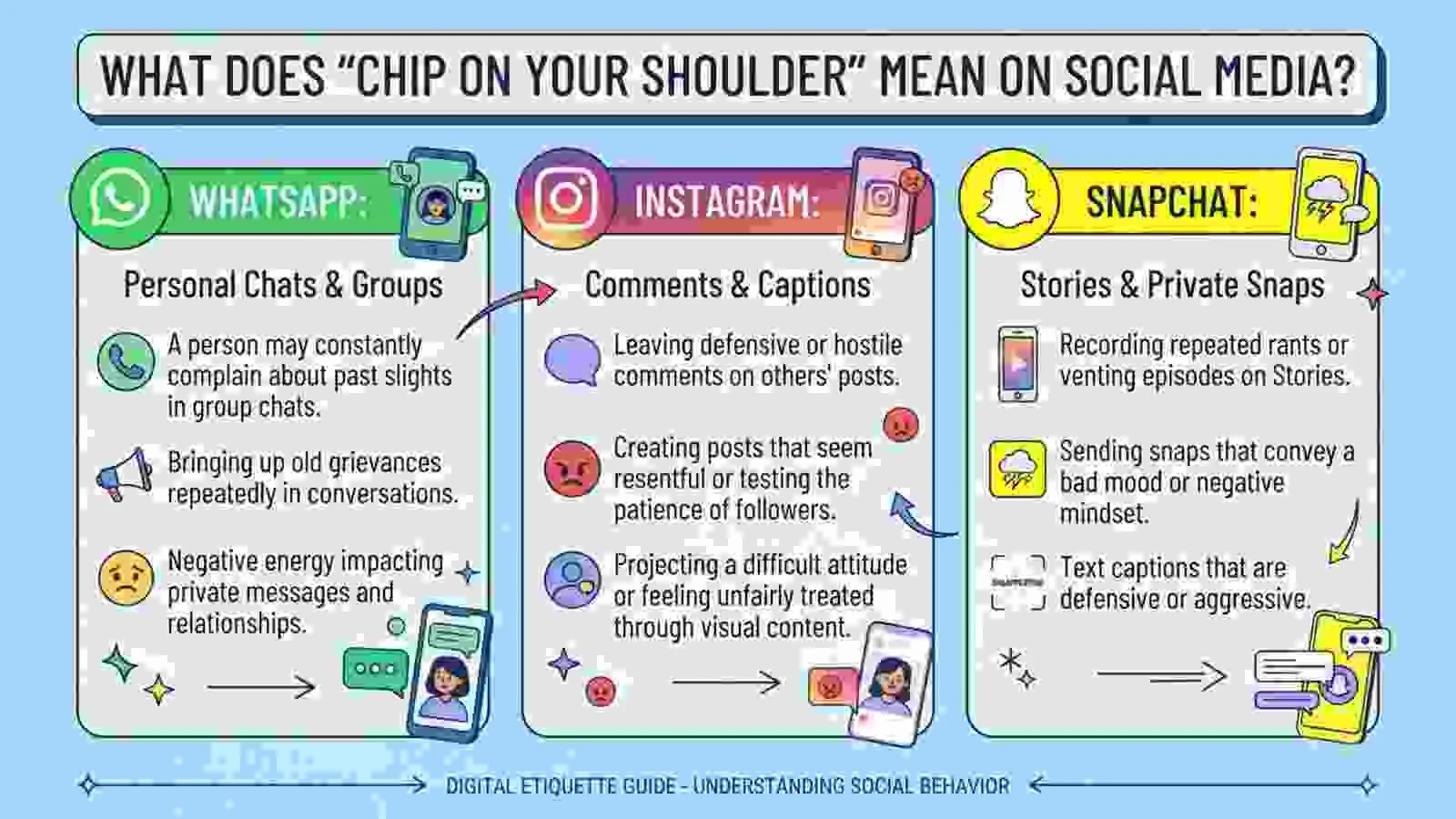
The meaning of this idiom does not change across social media platforms. It still describes someone who holds on to anger, feels wronged, or acts as if they have something to prove.
On WhatsApp
People may use it in private chats when talking about a friend, coworker, or family member.
Example:
“Ever since that argument, he has had a chip on his shoulder.”
On Instagram
The phrase may appear in comments, captions, or discussions about public figures and personal conflicts.
Example:
“She seems to have a chip on her shoulder about the criticism.”
On Snapchat
Friends may use it in casual conversations about arguments, competition, or hurt feelings.
Example:
“Why is he taking every joke so seriously? Does he have a chip on his shoulder?”
The phrase is an established English idiom, not platform-specific slang. Its tone may be serious, playful, or critical, depending on the message.
Similar Slang Words and Phrases Like “Chip on Your Shoulder”
Here are five related expressions that can help you describe similar feelings or behavior.
- Hold a grudge: To stay angry with someone because of something they did in the past.
- Take it personally: To feel that a comment or action is aimed at you.
- Have a short fuse: To become angry very quickly.
- Be defensive: To react as if you are being attacked or criticized.
- Have something to prove: To feel the need to show others that you are capable or successful.
These phrases are related, but they are not exact synonyms.
For example, someone who holds a grudge may stay angry about a past event. Someone who has a chip on their shoulder may also act as if they need to prove themselves.
Someone with a short fuse gets angry quickly, even if they are not upset about a past event.
FAQs About “Chip on Your Shoulder”
1. Is “chip on your shoulder” positive or negative?
It is usually negative. It often suggests that someone is bitter, defensive, or still upset about past treatment. However, the phrase does not tell the whole story about that person.
2. Is “chip on your shoulder” slang?
It is mainly an idiom, not modern internet slang. People have used it for a long time in everyday English.
3. Is it safe to use with elders?
You can use it when speaking with older people, but be careful. It may sound disrespectful if you use it to criticize their attitude. A softer phrase may be better.
4. Is “chip on your shoulder” common in daily chat?
Yes. People use it in conversations, text messages, social media discussions, and stories. It is more common among people who know the idiom.
5. Does “chip on your shoulder” mean someone is angry?
Often, yes. It usually describes someone who holds on to anger, feels unfairly treated, or reacts defensively. It can also suggest that the person feels the need to prove themselves.
6. What is the opposite of having a chip on your shoulder?
There is no single exact opposite. Phrases like “being at peace with the past,” “letting go of a grudge,” or “feeling secure in yourself” express similar ideas.
7. Can I use “chip on your shoulder” as a joke?
Yes, if the other person understands your humor and will not feel insulted. Since it can sound critical, avoid using it as a joke when someone is already upset.
Conclusion
“Chip on your shoulder” means that someone feels bitter, angry, or defensive because of past events or unfair treatment. It can also describe someone who feels they must prove themselves to others.
You may see this phrase in text messages, daily conversations, and social media posts. Its meaning stays the same on WhatsApp, Instagram, and Snapchat.
Now you know how to understand and use the idiom. Remember that it can sound critical, so think about the situation before using it to describe someone. If you want to be more polite, explain what you notice without judging the person.
Keep learning common English idioms and phrases to make your conversations clearer and more natural.

Ella Peterson is an English language writer and grammar enthusiast at MeaningZones.com. She focuses on clear and practical English grammar, vocabulary, sentence structure, and everyday language usage.
Through easy-to-understand explanations and helpful examples, Ella helps readers improve their English writing and communication skills. Her goal is to make English grammar simple, useful, and accessible to everyone.