Have you ever watched a scary movie and felt too afraid to keep watching?
Maybe your friend said, “This movie is not for the faint of heart!” You may have wondered what that phrase means.
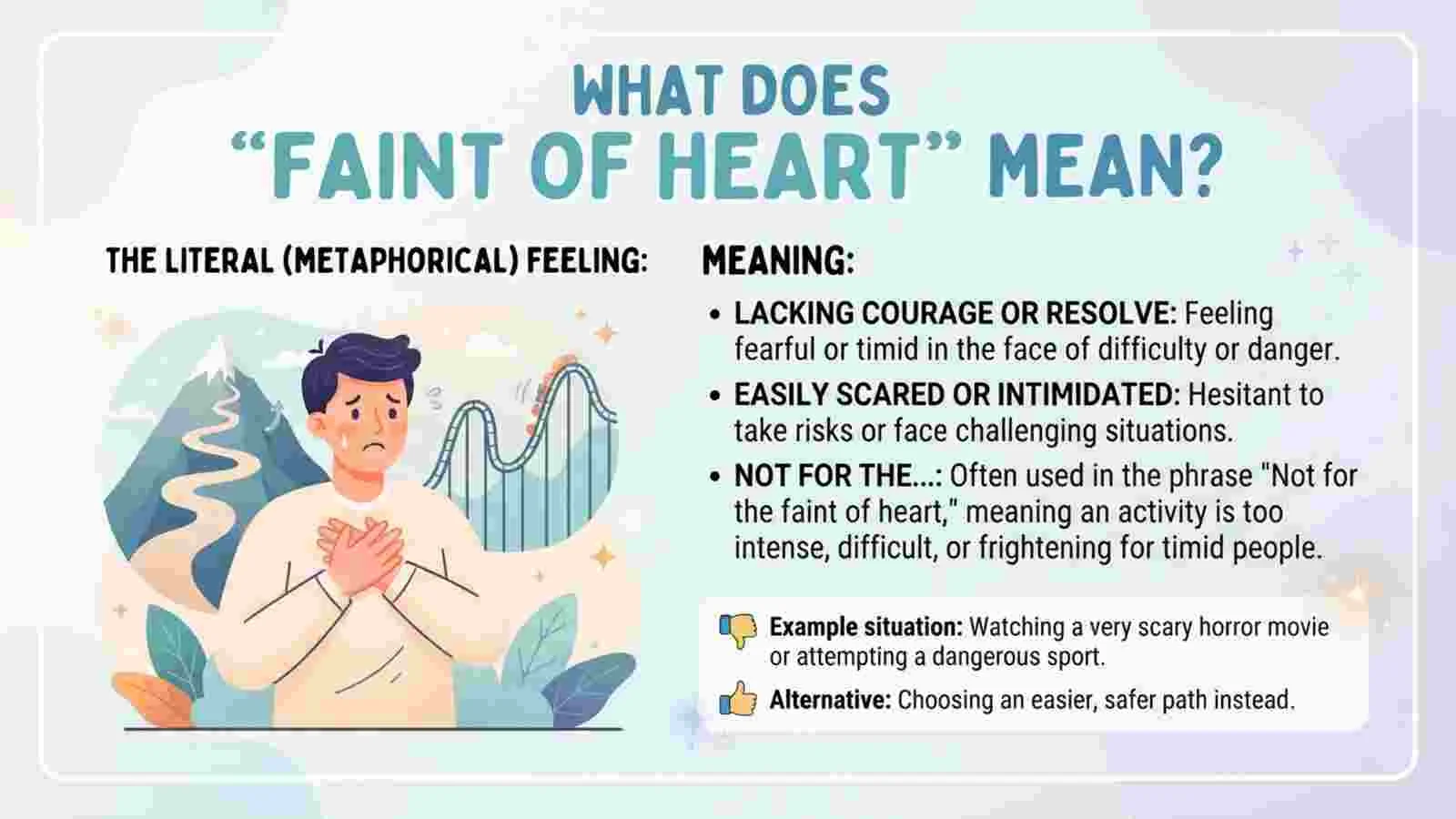
The phrase “faint of heart” means being easily scared, upset, or worried by something difficult or frightening. People use it when a situation may be too intense for some people to handle.
You may see this phrase in text messages, online posts, or daily talks. It can appear on WhatsApp, Instagram, and Snapchat. People also use it when talking about scary films, hard tasks, or shocking news.
In this guide, you will learn the meaning of “faint of heart,” how to use it in a sentence, and how to reply when someone says it. You will also see easy examples and similar phrases to help you understand it.
What Does “Faint of Heart” Mean in Text?
“Faint of heart” means someone who gets scared, upset, or nervous easily when faced with something hard or frightening.
The phrase often appears in the expression “not for the faint of heart.” This means that something may be too scary, intense, or difficult for some people.
For example:
- “This horror movie is not for the faint of heart.”
- “Starting your own business is not for the faint of heart.”
- “The news was shocking and not for the faint of heart.”
In simple words, the phrase means something takes courage or may be hard to handle.
It does not always mean physical fear. It can also describe a hard job, a risky choice, or an emotional challenge.
Full Form of “Faint of Heart”
“Faint of heart” has no full form. It is not an acronym or a texting abbreviation. It is a common English expression.
The word “faint” can mean weak or lacking strength. “Heart” often refers to courage or feelings in this phrase.
Together, the words describe someone who may lack the courage to face something frightening or difficult.
The phrase is also linked to the expression “not for the faint-hearted.” Both expressions have a similar meaning.
For example:
“This challenge is not for the faint-hearted.”
This means the challenge may be too hard or scary for people who do not feel ready to face it.
How Is “Faint of Heart” Used in Chat?
People use this phrase in chats to describe something scary, shocking, risky, or hard to deal with.
Here are three simple examples.
Example 1: Talking About a Horror Movie
Alex: “Have you watched that new horror film?”
Sam: “Yes, but it’s not for the faint of heart!”
Sam means the movie is very scary.
Example 2: Talking About a Hard Task
Mia: “I want to start my own business.”
Lily: “That’s exciting! But it is not for the faint of heart.”
Lily means starting a business takes courage and hard work.
Example 3: Sharing Shocking News
Noah: “I saw the most shocking video today.”
Jake: “Was it really that bad?”
Noah: “Yes. It was not for the faint of heart.”
Noah means the video may upset or shock some viewers.
What Does “Faint of Heart” Mean From a Girl or Boy?
The meaning does not change based on who says it. However, the tone may depend on the person and the situation.
When a Girl Says It
A girl may use this phrase to warn you about something scary or intense.
For example:
Girl: “Don’t watch this video if you’re faint of heart!”
She may be warning you that the video contains disturbing or frightening content.
She might also use it in a playful way when talking about a difficult challenge.
When a Boy Says It
A boy may use the phrase to describe a risky activity, a scary movie, or a hard experience.
For example:
Boy: “That roller coaster is not for the faint of heart.”
He means the ride may be too intense for some people.
Can It Be Flirty?
The phrase is not usually flirty by itself. But someone may use it playfully while teasing a friend or romantic partner.
For example:
“Think you can handle this scary movie, or are you faint of heart?”
This may be friendly teasing. It does not automatically mean romantic interest.
Always look at the full conversation before guessing someone’s feelings.
Is “Faint of Heart” Rude or Polite?
The phrase is usually neutral. It can be a friendly warning about something scary or difficult.
For example:
“This game is not for the faint of heart.”
This simply means the game is intense or challenging.
However, the phrase can sound rude if someone uses it to insult another person’s courage.
For example:
“You are too faint of heart to try this.”
This may sound like the speaker is calling the other person weak or scared.
To keep the phrase polite, use it to describe the activity rather than attack a person.
Polite example: “This challenge can be tough, so it may not be for everyone.”
When Should You Use “Faint of Heart”?
You can use this phrase in casual talks, online chats, and everyday situations.
- When talking about a scary movie.
- When warning someone about shocking images or videos.
- When describing a risky adventure.
- When talking about a difficult job or challenge.
- When discussing an intense game or sport.
- When joking with friends about something frightening.
Example: “The final level of this game is not for the faint of heart.”
The phrase works best when the situation truly requires courage or may be hard to handle.
When Should You NOT Use “Faint of Heart”?
Although the phrase is common, it may not fit every situation.
- Avoid using it to mock someone who feels afraid.
- Do not use it to dismiss someone’s real fear or pain.
- Avoid it in serious talks where a person needs comfort.
- Do not use it as a label for someone who is dealing with a difficult experience.
- Avoid it in formal writing if a clearer phrase would work better.
For example, if a friend is scared about a medical test, saying “You’re faint of heart” may sound unkind.
A better reply would be:
“I know this is scary. I’m here for you.”
Best Replies to “Faint of Heart”
Your reply depends on the tone of the conversation. Here are five short and natural options.
- “I’m ready for the challenge!” — Use this when you feel confident.
- “Now I’m curious!” — Use this when someone warns you about something scary.
- “Maybe I’ll skip this one!” — Use this when you do not want to try it.
- “I can handle it!” — Use this when you want to sound brave.
- “Thanks for the warning!” — Use this when someone warns you about disturbing or intense content.
You can also reply with humor.
For example:
Friend: “This movie is not for the faint of heart.”
You: “Great! I’ll keep a pillow ready to hide behind.”
“Faint of Heart” Meaning on WhatsApp, Instagram, and Snapchat
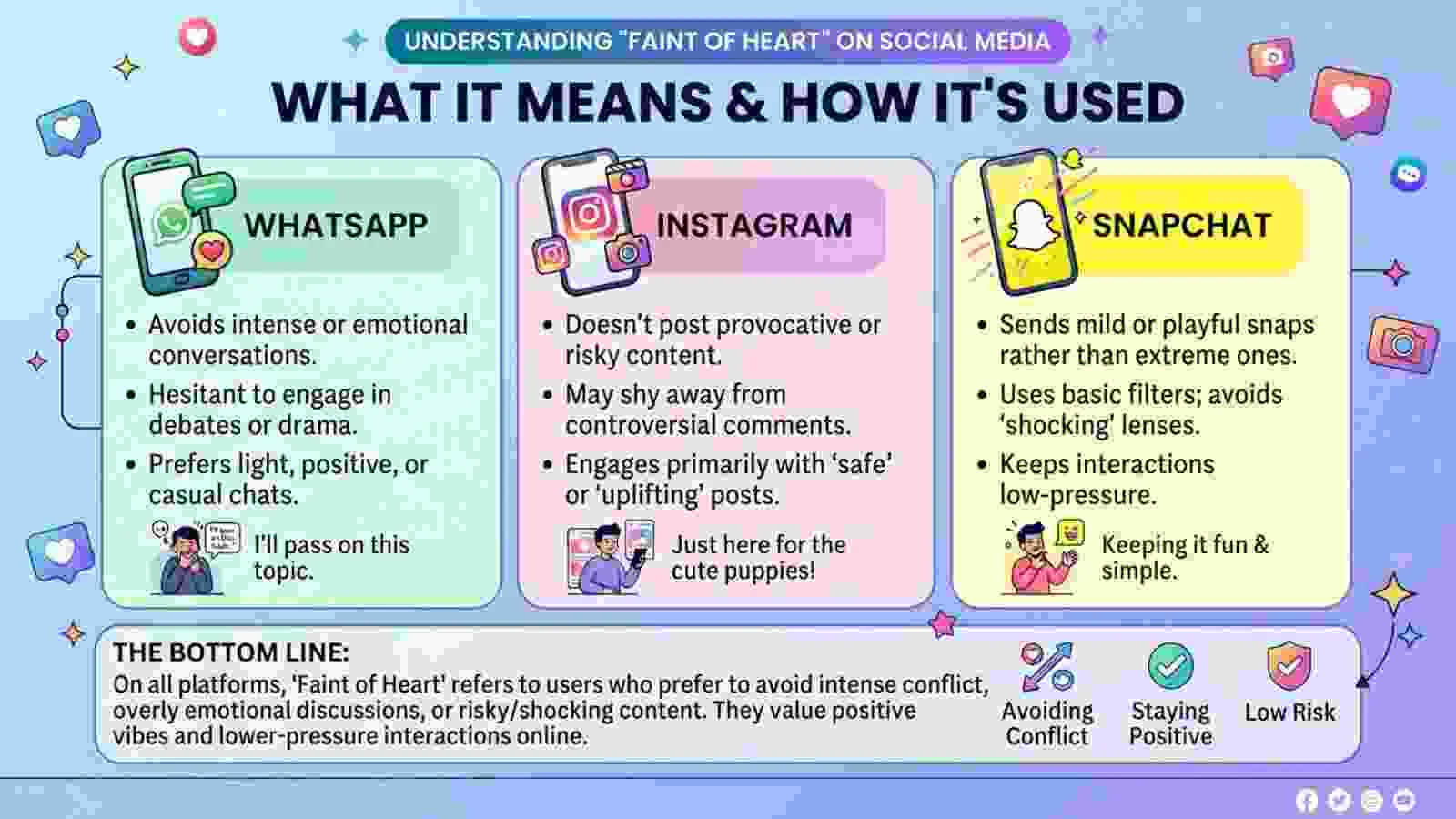
The meaning stays the same across these platforms. It describes someone who may struggle with something scary, upsetting, or difficult.
On WhatsApp
Friends may use the phrase to warn each other about a scary video or movie.
Example: “Don’t watch this alone. It’s not for the faint of heart!”
On Instagram
People may use it in captions or comments about intense workouts, extreme sports, or shocking content.
Example: “This mountain trail is not for the faint of heart.”
On Snapchat
Someone may use it in a message about a scary experience or a daring activity.
Example: “That haunted house was not for the faint of heart!”
The phrase is not platform-specific slang. It is a regular English idiom used online and offline.
Similar Slang Words and Phrases Like “Faint of Heart”
Here are five related expressions that can help you understand the phrase better.
- Scaredy-cat: A casual term for someone who gets scared easily.
- Chicken: Informal slang for someone who is afraid to do something.
- Fearless: Describes someone who seems brave and not easily scared.
- Brave-hearted: Describes someone who shows courage.
- Not for the weak: An informal phrase for something very hard or intense.
These expressions are not exact matches. For example, “scaredy-cat” often teases a person, while “not for the faint of heart” usually describes an activity or experience.
FAQs About “Faint of Heart”
1. Is “faint of heart” positive or negative?
It depends on the context.
Can be a neutral warning about something difficult. It may sound negative if used to call someone weak or scared.
2. Is “faint of heart” slang?
No. It is a common English idiom, not modern texting slang. People use it in everyday talks, books, movies, and online posts.
3. Is it safe to use with elders?
Yes. The phrase is generally suitable for everyday conversations with older people. Use a respectful tone and avoid using it to insult someone.
4. Is “faint of heart” common in daily chat?
Yes, people use it in chats and daily talks, especially when discussing scary movies, hard tasks, or intense experiences.
5. What does “not for the faint of heart” mean?
It means something may be too scary, difficult, shocking, or intense for some people to handle comfortably.
6. Is “faint of heart” the same as “faint-hearted”?
They have similar meanings. “Faint-hearted” describes someone who lacks courage or gets scared easily. “Not for the faint of heart” usually describes an activity or experience.
7. Can I use “faint of heart” as a joke?
Yes, you can use it playfully with friends. Just make sure the joke does not hurt someone who is genuinely scared or upset.
Conclusion
“Faint of heart” means being easily scared, upset, or nervous when facing something difficult. The phrase “not for the faint of heart” warns that an activity or experience may be intense, scary, or hard to handle.
You may see it in text messages, social media posts, movie reviews, and daily conversations. It can describe anything from a frightening horror film to a tough challenge.
Now you know what the phrase means and how to use it in the right way. Remember that it is usually a neutral expression, but it can sound rude if used to mock someone.
If you want to improve your English, explore more common idioms and phrases. They can help you understand online conversations and express your thoughts with ease.

William Bennett is a dedicated writer and language enthusiast who shares clear, helpful insights on word meanings, spelling, grammar, and everyday English.
As an author at MeaningZones.com, he aims to make confusing language topics simple, practical, and easy for readers to understand.