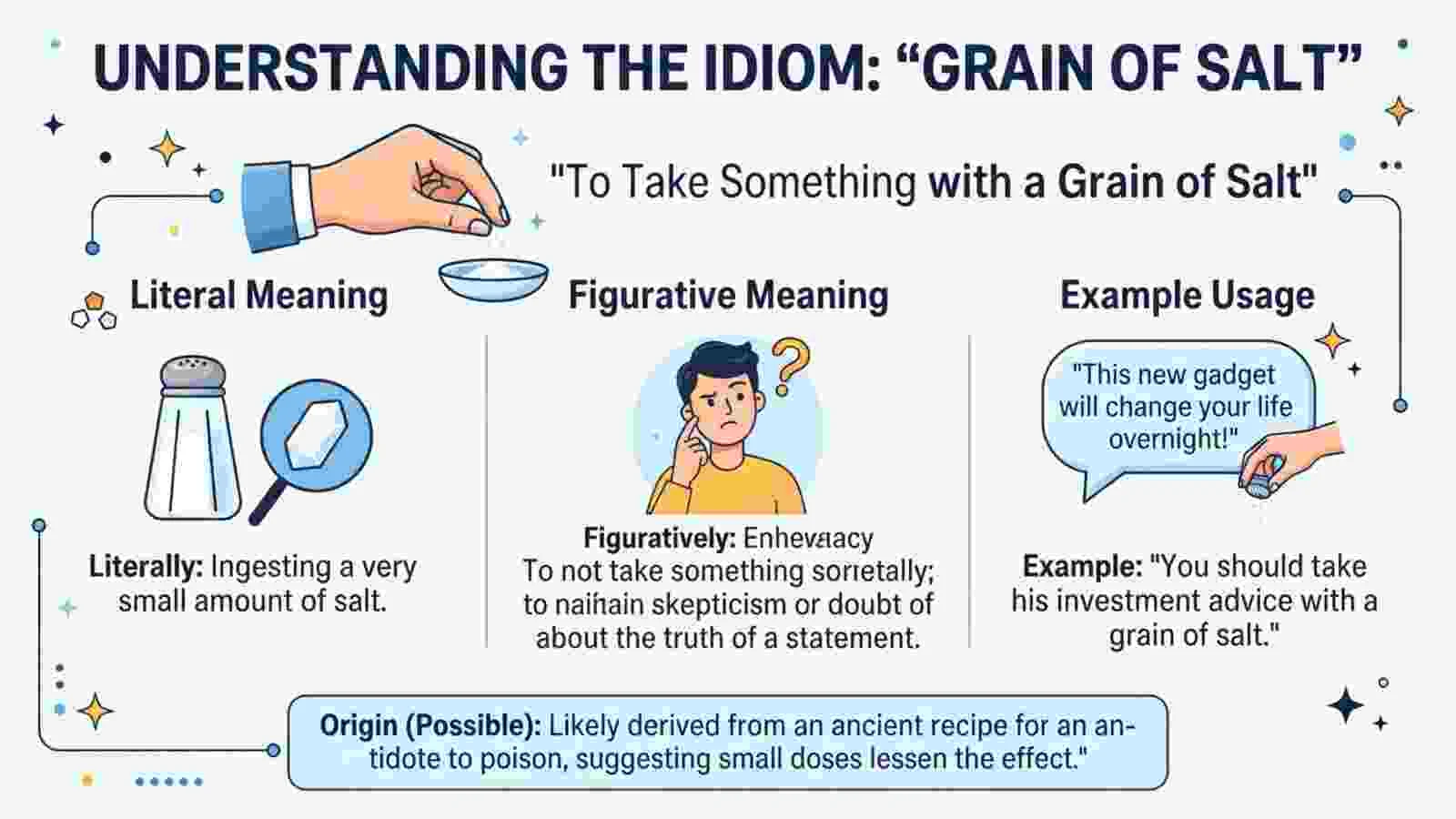
Have you ever heard someone say, “Take that with a grain of salt”?
You may have seen this phrase in a text message, on Instagram, or in a chat with a friend. At first, it may sound like someone is talking about food. But that is not what it means!
“Grain of salt” means you should not believe something completely without checking it first. It tells you to be careful about what you hear or read.
People use this phrase when they talk about rumors, online news, advice, or claims that may not be true. You might see it on WhatsApp, Snapchat, or other social media sites.
In this guide, you will learn the grain of salt meaning, how to use it in chats, and how to reply when someone says it. You will also see easy examples to help you understand this common English phrase.
What Does “Grain of Salt” Mean in Text?
“Grain of salt” means to view something with care and not believe it right away. The full phrase is usually “take something with a grain of salt.”
In simple words, it means you should question a claim instead of trusting it fully.
For example:
- “Take his story with a grain of salt.”
- “I heard a rumor, but I’ll take it with a grain of salt.”
- “Take online reviews with a grain of salt.”
In each example, the speaker says that the information may not be fully true.
What does “take it with a grain of salt” mean?
It means you should keep an open mind. Do not accept every claim as a fact. Check the details before you believe it.
For example:
Friend 1: “I heard our school will close next week.”
Friend 2: “Take that with a grain of salt until the school confirms it.”
The second friend does not know if the news is true. They suggest waiting for proof.
Full Form of “Grain of Salt”
“Grain of salt” has no full form. It is not an acronym or an abbreviation. It is a common English idiom.
A grain is a very small piece of something. A grain of salt is a tiny amount of salt.
But in this phrase, the words have a figurative meaning. They tell you to be careful when judging information.
The phrase is often used when someone shares a rumor, gives advice, or makes a claim that may be wrong.
For example:
“Take that advice with a grain of salt.”
This means you should think about the advice before following it. It does not mean the advice is always wrong. It means you should not trust it without thought.
How Is “Grain of Salt” Used in Chat?
People use this phrase in chats when they want others to be careful about information.
Here are three simple examples.
Example 1: Talking About a Rumor
Alex: “Someone said our favorite singer is leaving music.”
Mia: “Take that with a grain of salt. There is no official news yet.”
Mia says the rumor may not be true.
Example 2: Talking About Online Reviews
Sam: “This phone has only five-star reviews!”
Lily: “Take those reviews with a grain of salt. Some may not be real.”
Lily suggests checking the reviews before trusting them.
Example 3: Talking About Advice
Noah: “My friend says this is the best way to learn English.”
Emma: “Take that with a grain of salt. What works for one person may not work for everyone.”
Emma explains that advice can be useful but may not suit every person.
These examples show that the phrase helps people share doubt in a calm and simple way.
What Does “Grain of Salt” Mean From a Girl or Boy?
The meaning does not change based on who says it. A girl or boy may use the phrase to show doubt, give advice, or warn someone about a claim.
The tone depends on the chat and the relationship.
When a Girl Says “Take It With a Grain of Salt”
She may be telling you not to trust something too quickly.
Example:
Girl: “He said he will come, but take that with a grain of salt.”
She may doubt whether he will keep his word.
This does not always mean she is upset or jealous. She may simply be sharing her view.
When a Boy Says “Take It With a Grain of Salt”
A boy may use the phrase when he thinks a story or claim needs proof.
Example:
Boy: “I heard the game will launch next month, but take that with a grain of salt.”
He is saying that the release date may change or may not be true.
Can It Be Flirty?
The phrase is not usually flirty on its own. It is more about doubt or caution.
A person may use it in a playful chat, but you should not assume romantic interest from this phrase alone.
Is “Grain of Salt” Rude or Polite?
The phrase is usually polite and neutral. It lets you show doubt without directly calling someone a liar.
For example:
“Take that claim with a grain of salt.”
This sounds less harsh than saying, “That person is lying.”
However, the phrase can sound rude if you use it to dismiss someone’s story or make fun of their opinion.
Polite example:
“I would take that advice with a grain of salt until we know more.”
Less polite example:
“Everything you say should be taken with a grain of salt.”
The second sentence may sound like you do not trust the person at all.
Use the phrase with care when talking about someone’s feelings, personal experience, or serious concerns.
When Should You Use “Grain of Salt”?
You can use this phrase in many everyday situations.
- When you hear a rumor that has not been confirmed.
- When you read online reviews that may not be honest.
- When someone shares advice that may not work for everyone.
- When you see a claim on social media.
- When a person makes a promise that seems uncertain.
- When you want someone to check facts before believing a story.
Example: “Take that post with a grain of salt until you find a trusted source.”
The phrase is useful because it encourages people to think before they believe something.
When Should You NOT Use “Grain of Salt”?
Although the phrase is common, it does not fit every situation.
- Avoid using it to mock someone’s honest feelings.
- Do not use it to dismiss a serious problem without listening.
- Avoid saying it in a way that makes someone feel foolish.
- Do not use it as a reason to ignore strong evidence.
- Avoid using it when a direct, clear warning is needed.
For example, if someone shares an urgent safety warning, do not dismiss it without checking reliable sources.
The phrase means you should be careful, not that you should reject everything you hear.
Best Replies to “Grain of Salt”
If someone tells you to take something with a grain of salt, you can reply in different ways.
Here are five short and natural replies.
- “Good point. I’ll check first.” — Shows that you understand.
- “You’re right. It may not be true.” — Agrees with the warning.
- “I’ll wait for more proof.” — Shows that you want reliable facts.
- “Thanks for the heads-up!” — A friendly reply.
- “Let’s see if there is a trusted source.” — Suggests checking the facts.
You can also ask a question if you need more information.
Example:
Friend: “Take that news with a grain of salt.”
You: “Do you know if there is any proof?”
This keeps the conversation clear and respectful.
“Grain of Salt” Meaning on WhatsApp, Instagram, and Snapchat
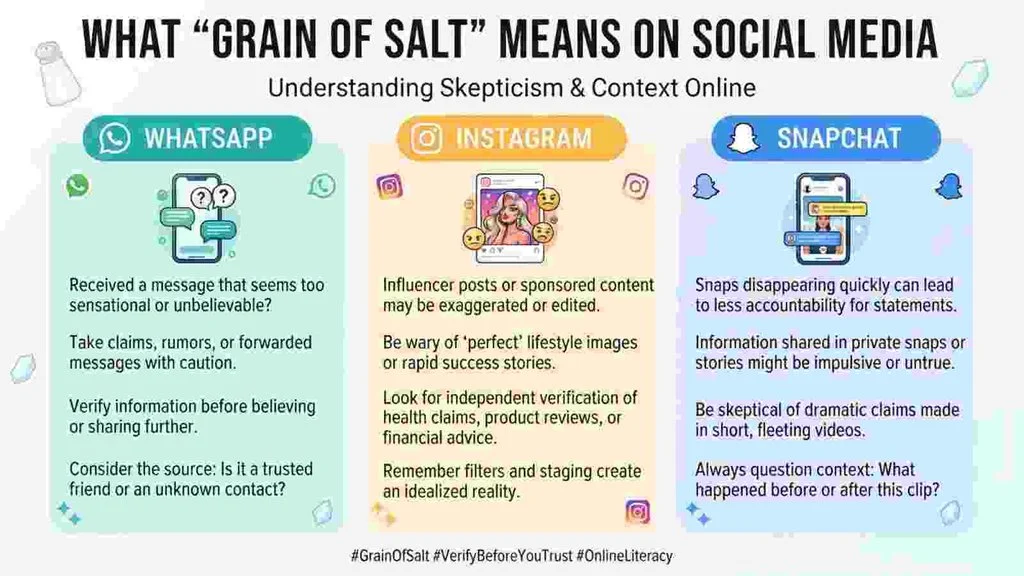
The meaning of “grain of salt” stays the same across these platforms. It means you should be careful about believing something.
On WhatsApp
People may use it when sharing news, rumors, or messages in group chats.
Example: “Someone sent this news in the group, but take it with a grain of salt.”
This means the message may need fact-checking.
On Instagram
The phrase may appear in comments, captions, or direct messages.
Example: “Take celebrity rumors with a grain of salt until there is an official statement.”
The speaker warns others not to believe every online claim.
On Snapchat
Friends may use the phrase when talking about gossip, plans, or something they heard.
Example: “He said the party is canceled, but take that with a grain of salt.”
The speaker is not sure the news is true.
The phrase is not special slang for any one app. It is a common idiom that people use both online and in real life.
Similar Slang Words and Phrases Like “Grain of Salt”
Here are five related phrases that can help you express doubt or caution.
- Take it with a pinch of salt: Has the same meaning as “take it with a grain of salt.” It is common in British English.
- Don’t jump to conclusions: Do not decide that something is true before you have enough facts.
- Question everything: Think carefully about claims instead of accepting them right away.
- Be skeptical: Do not believe something fully until you have good reasons.
- Fact-check: Check whether information is true by using reliable sources.
These phrases are related, but they are not always interchangeable.
For example, “fact-check” means to verify information. “Take it with a grain of salt” means to remain cautious about it.
FAQs About “Grain of Salt”
1. Is “grain of salt” positive or negative?
It is usually neutral. It means you should be careful before believing something. It does not always mean the information is false.
2. Is “grain of salt” slang?
No. It is a common English idiom. People use it in texts, daily talks, work chats, and social media.
3. Is it safe to use with elders?
Yes. The phrase is generally polite. You can use it with older people, friends, and coworkers. Keep your tone respectful.
4. Is “grain of salt” common in daily chat?
Yes. People use it when talking about rumors, advice, online posts, and claims that may not be true.
5. What does “take it with a grain of salt” mean?
It means you should not believe something completely without checking it. You should consider that it may be wrong or incomplete.
6. Is “grain of salt” the same as “pinch of salt”?
Yes. Both phrases can mean the same thing when used in this idiom. “Grain of salt” is common in American English, while “pinch of salt” is common in British English.
7. Can I use “grain of salt” at work?
Yes. It can be useful in work chats and meetings when discussing claims or advice that need more proof. For formal writing, you may choose a phrase like “this information should be verified.”
Conclusion
The phrase “grain of salt” means you should be careful about believing something. The full expression, “take it with a grain of salt,” tells you not to accept a claim as true without thinking about it first.
People use it when talking about rumors, online news, reviews, advice, and social media posts. It works in WhatsApp messages, Instagram chats, Snapchat conversations, and everyday talks.
The phrase is usually polite, but your tone matters. Use it to encourage careful thinking, not to insult someone or dismiss their feelings.
Now you know what “grain of salt” means and how to use it in the right way. Keep learning common English idioms and phrases to make your chats clearer and more natural.
Continue Reading:
- Gird Your Loins Meaning: Definition, Origin, and Examples ( for 2026)
- Hakuna Matata in English: Language, Culture, and Examples ( for 2026)
- I Plead the Fifth Meaning: Definition, Origin, and Examples ( for 2026)

William Bennett is a dedicated writer and language enthusiast who shares clear, helpful insights on word meanings, spelling, grammar, and everyday English.
As an author at MeaningZones.com, he aims to make confusing language topics simple, practical, and easy for readers to understand.








1 thought on “Grain of Salt Meaning: Definition, Examples, and Usage ( for 2026)”