Have you ever watched a movie where the hero is in big trouble?
The villain is about to win. There seems to be no way out. Then, out of nowhere, a new character appears and saves the day.
The problem is solved in seconds. You may wonder, “Where did that come from?”
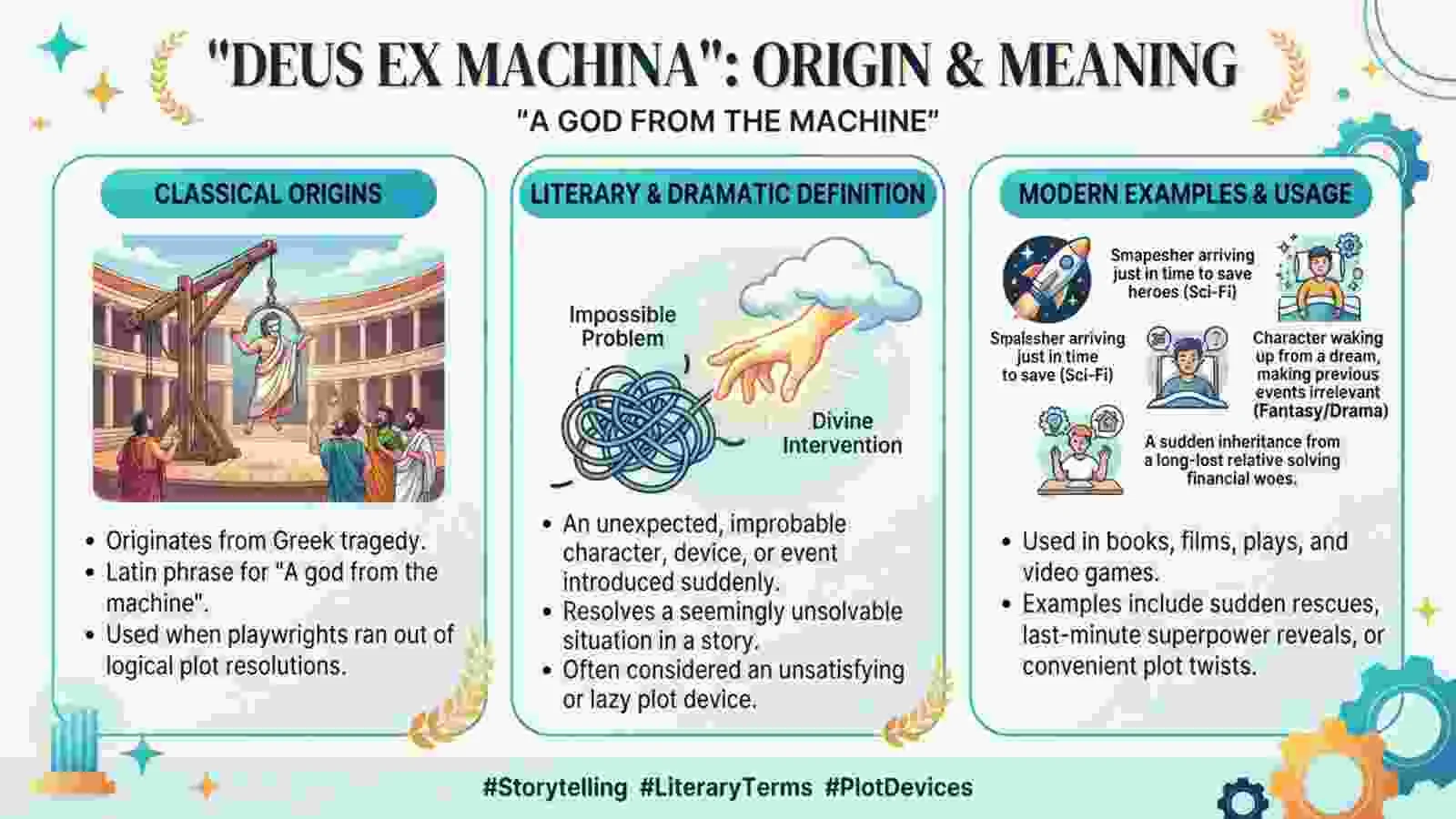
This is a good example of deus ex machina. It is a term used in books, movies, plays, and stories. It describes a sudden event or surprise that fixes a problem in an unexpected way.
You may see this phrase in online chats, movie reviews, or posts on WhatsApp, Instagram, and Snapchat. People often use it when a story has an easy or forced ending.
In this guide, you will learn the deus ex machina meaning, see simple examples, and find out how to use this phrase in daily conversations.
What Does “Deus Ex Machina” Mean in Text?
Deus ex machina means a sudden and unexpected solution to a hard problem in a story. It often happens when a character or event saves the day without a clear reason or setup.
For example, a hero is trapped in a locked room. Just as all hope seems lost, a stranger appears with the key. The hero escapes, even though the stranger was never part of the story before.
That surprise rescue may be called a deus ex machina.
People also use this term in online chats to describe an event that solves a problem in a way that feels too easy or unlikely.
Example:
Alex: The hero had no way to win that fight.
Sam: I know! Then a new character showed up and beat the villain. Total deus ex machina!
In simple words, it means a sudden fix that comes out of nowhere.
Full Form of “Deus Ex Machina”
Deus ex machina is not an acronym, so it has no full form. It is a Latin phrase.
Its literal meaning is “god from the machine.”
The phrase comes from ancient Greek theater. In some plays, a god or other powerful figure would appear through a stage device to solve a problem or end the story.
Over time, the phrase came to describe any sudden solution that seems to come from nowhere.
Today, people use it when talking about books, films, TV shows, video games, and even real-life events.
How Is “Deus Ex Machina” Used in Chat?
People often use this phrase when they talk about a surprising event or an ending that feels too easy.
Here are three simple chat examples.
Example 1: Talking About a Movie
Mia: Did you like the movie ending?
Noah: Not really. The hero was about to lose, but a stranger saved him.
Mia: Yeah, that felt like a deus ex machina.
Here, Mia means the ending solved the problem in a sudden and unlikely way.
Example 2: Talking About a TV Show
Alex: How did the team escape the island?
Sam: A rescue boat just appeared out of nowhere.
Alex: That sounds like a deus ex machina!
Alex thinks the rescue was too convenient.
Example 3: Talking About Real Life
Lily: I thought I would miss my exam because my car broke down.
Jake: What happened?
Lily: My friend drove past and gave me a ride just in time.
Jake: Wow! That was like a deus ex machina.
Jake uses the phrase to describe an unexpected event that solved a big problem. In real life, though, people may use it more loosely than they do in literary criticism.
What Does “Deus Ex Machina” Mean From a Girl or Boy?
The phrase has the same basic meaning no matter who uses it. The tone depends on the conversation.
When a girl says it
A girl may use deus ex machina when talking about a movie, book, or surprising event.
For example:
Girl: “The ending was so strange. The hero got saved by a random person. Total deus ex machina.”
She may be joking or giving her opinion about the story.
When a boy says it
A boy may use the phrase when discussing a game, movie, or story that has an unlikely solution.
For example:
Boy: “The final boss was too strong, and then the game gave us a magic weapon. That was a deus ex machina.”
He is saying the solution felt sudden and convenient.
Can it be flirty?
The phrase is not normally flirty. It is mostly used to discuss stories, plots, and unexpected solutions.
Someone might use it as a joke in a personal chat, but it does not have a special romantic meaning.
Is “Deus Ex Machina” Rude or Polite?
Deus ex machina is not a rude or offensive phrase. It is a literary term used to explain how a story solves a problem.
However, it can sound critical when you use it to describe someone’s writing or creative work.
For example:
- Neutral: “The ending uses a deus ex machina.”
- Critical: “Your story relies on a deus ex machina instead of building a strong ending.”
- Playful: “My friend showed up with food just when I was starving. Deus ex machina!”
The second example may upset a writer because it suggests that the story’s ending feels weak or poorly planned.
If you want to give kind feedback, explain why the solution feels sudden. You can say, “The ending might feel stronger if the rescue were set up earlier.”
When Should You Use “Deus Ex Machina”?
You can use this phrase when discussing stories or describing an unexpected solution.
- When reviewing a movie with a sudden ending.
- When talking about a book with an unlikely rescue.
- When discussing a video game with an easy fix.
- When explaining how a problem was solved by chance.
- When joking about a lucky event that saved the day.
- When studying plays, films, or storytelling.
Example: “The writer used a deus ex machina to save the main character.”
The phrase works best when the other person understands the topic or is open to learning a new term.
When Should You NOT Use “Deus Ex Machina”?
Although the phrase is useful, it does not fit every conversation.
- Do not use it when a simple phrase like “lucky escape” would be clearer.
- Avoid using it with people who may not know the term unless you explain it.
- Do not use it to insult a writer without giving a reason.
- Avoid using it in urgent situations where people need clear instructions.
- Do not call every surprise a deus ex machina. The event should solve a problem in a sudden or unlikely way.
For example, a planned rescue that was carefully set up earlier in a story is not always a deus ex machina.
The term usually applies when the solution feels unearned or comes from outside the story’s established events.
Best Replies to “Deus Ex Machina”
If someone uses this phrase in a chat, your reply can be simple and natural.
Here are five examples.
- “Exactly! It came out of nowhere.” — Use this when you agree.
- “Yeah, the ending felt too easy.” — Use this when a story’s solution seems weak.
- “I actually liked the surprise!” — Use this when you enjoyed the ending.
- “Can you explain what that means?” — Use this if the term is new to you.
- “Maybe, but it made the story more fun.” — Use this when you have a different opinion.
You can also ask, “Do you mean the sudden rescue at the end?”
This shows that you want to understand the person’s point.
“Deus Ex Machina” Meaning on WhatsApp, Instagram, and Snapchat

The meaning of deus ex machina stays the same across social media platforms. It does not have a different official meaning on WhatsApp, Instagram, or Snapchat.
However, people may use it in different ways.
On WhatsApp
Friends may use the phrase while discussing a movie or a surprising event.
Example: “That ending was pure deus ex machina 😂”
The laughing emoji may show that the person found the ending silly or funny.
On Instagram
People may use the phrase in comments on movie clips, book reviews, or posts about storytelling.
Example: “The last scene was a classic deus ex machina.”
The person is saying that the story’s solution appeared suddenly.
On Snapchat
Someone may use the term in a private chat about a show, game, or lucky event.
Example: “My brother brought my charger just in time. Deus ex machina!”
Here, the phrase is used in a playful way.
The key point is that deus ex machina is a literary term, not a texting abbreviation. Its meaning stays the same, even when people use it casually online.
Similar Words and Phrases Like “Deus Ex Machina”
Here are five related terms that can help you describe a sudden or surprising event.
- Plot twist: An unexpected change in a story that surprises the audience.
- Lucky break: A piece of good luck that helps someone.
- Convenient coincidence: An event that happens at just the right time, sometimes seeming too perfect.
- Last-minute rescue: Help that arrives just before something goes wrong.
- Quick fix: A fast solution to a problem, which may not solve everything in the long run.
These phrases are related, but they do not mean exactly the same thing.
A plot twist changes what the audience expects. A lucky break is a fortunate event. A deus ex machina is a sudden solution that resolves a difficult problem, often without enough setup.
FAQs About “Deus Ex Machina”
1. Is deus ex machina positive or negative?
It can be either. Some people enjoy a sudden rescue, while others feel it makes a story weak or unrealistic. It depends on how well the solution fits the story.
2. Is deus ex machina slang?
No. It is a Latin phrase and a literary term. People sometimes use it casually in chats, but it is not traditional internet slang.
3. Is it safe to use with elders?
Yes. The phrase is not rude or offensive. However, it is not a common everyday expression, so you may need to explain it.
4. Is deus ex machina common in daily chat?
It is not as common as short forms like LOL or BRB. You are more likely to see it in movie reviews, book discussions, gaming chats, and conversations about storytelling.
5. What is a simple meaning of deus ex machina?
It means a sudden and unexpected solution to a problem, especially in a story.
6. What is the literal meaning of deus ex machina?
It means “god from the machine” in Latin. The phrase comes from ancient theater, where a god could appear through a stage device to solve a problem.
7. Is every plot twist a deus ex machina?
No. A plot twist is any major surprise or change in a story. A deus ex machina is a specific kind of sudden solution, often one that feels unearned or poorly set up.
Conclusion
The phrase deus ex machina means a sudden and unexpected solution to a difficult problem, especially in a story.
It often describes a moment when a character is saved by an event or person that appears out of nowhere.
You may see it in movie reviews, book discussions, gaming chats, or messages on WhatsApp, Instagram, and Snapchat. It is not slang in the usual sense, and it is not rude. It is a literary term that people also use in casual conversations.
Now you know what deus ex machina means and how to use it. Remember that it does not describe every surprise. It usually refers to a solution that feels too sudden or convenient.
Keep learning new English phrases and idioms. They can help you understand online discussions, enjoy stories, and express your thoughts with more confidence.
Continue Reading:
- Gird Your Loins Meaning: Definition, Origin, and Examples ( for 2026)
- Hakuna Matata in English: Language, Culture, and Examples ( for 2026)
- I Plead the Fifth Meaning: Definition, Origin, and Examples ( for 2026)

William Bennett is a dedicated writer and language enthusiast who shares clear, helpful insights on word meanings, spelling, grammar, and everyday English.
As an author at MeaningZones.com, he aims to make confusing language topics simple, practical, and easy for readers to understand.