Have you ever heard someone say, “Social media is a double edged sword”? You may wonder what they mean. Is social media good or bad? The answer is both!
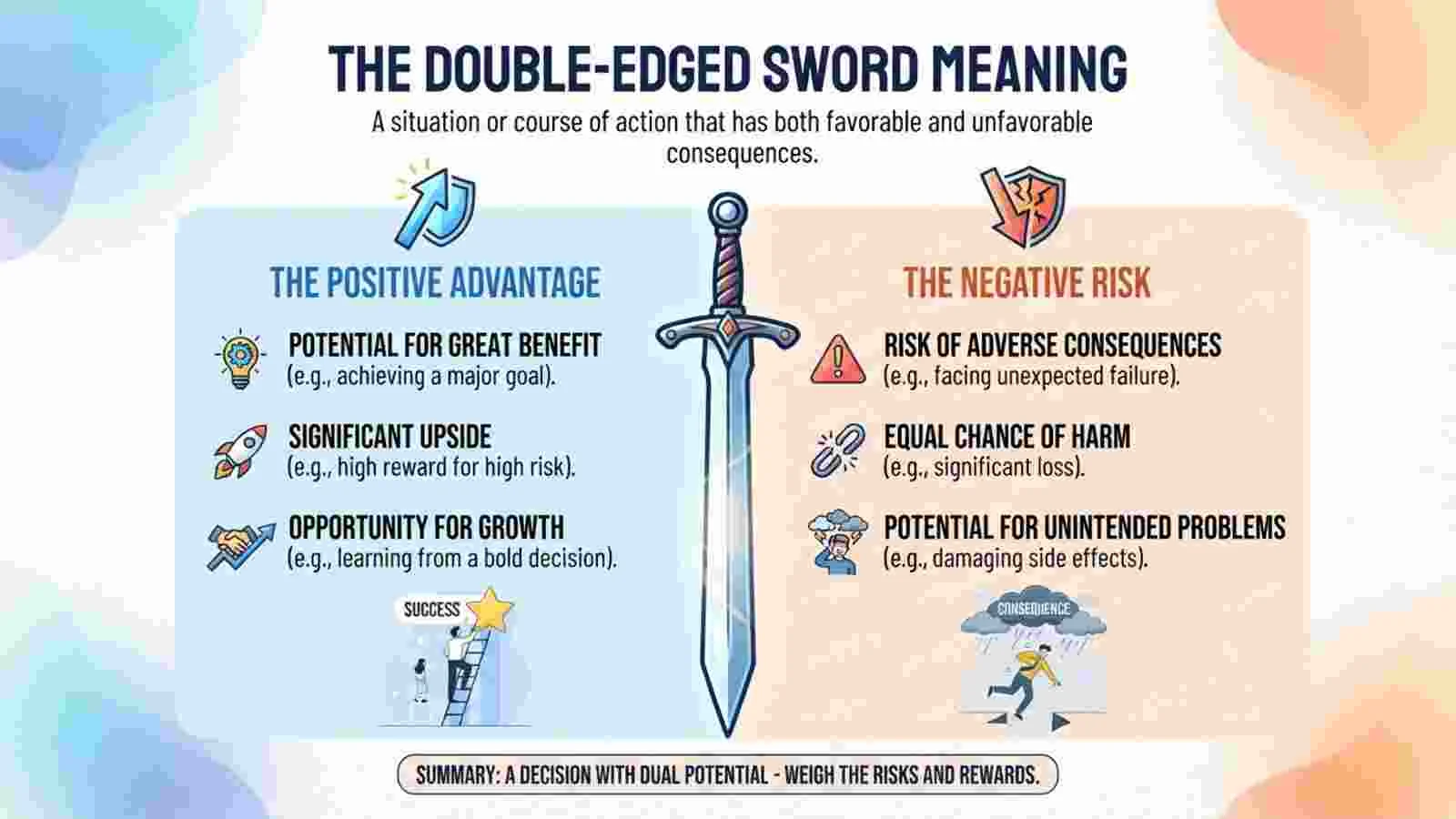
The phrase “double edged sword” means something that has both good and bad sides. It can bring benefits, but it can also cause problems.
The same thing that helps you in one way may hurt you in another.
You may see this phrase in text messages, online posts, or daily talks. People use it on WhatsApp, Instagram, and Snapchat to talk about things that have mixed effects.
It can describe social media, money, fame, technology, or even love.
In this guide, you will learn the double edged sword meaning, how to use it in chats, and what it means when a girl or boy says it. You will also find simple examples and common replies.
What Does Double Edged Sword Mean in Text?
A double edged sword is something that has both advantages and disadvantages. It can help you in one way but cause trouble in another.
For example, having a lot of money can give you comfort and freedom. But it can also bring stress, unwanted attention, or family problems.
Here is another example:
“Being famous is a double edged sword.”
This means fame can bring success and new chances. However, it can also reduce privacy and bring unwanted attention.
In simple words, a double edged sword is something that has both positive and negative effects.
People use this phrase when they want to explain that something is not fully good or fully bad. Its results depend on how it is used or how it affects a person.
Full Form of Double Edged Sword
“Double edged sword” has no full form. It is not an acronym or an abbreviation. It is an English idiom.
The phrase comes from the idea of a sword with two sharp edges. Such a sword can cut in more than one direction. In the same way, something described as a double edged sword can have two sides: one helpful and one harmful.
For example, the internet is a double edged sword. It helps people learn new things and stay in touch. At the same time, it can spread false news and waste time.
The phrase is common in daily English, news stories, books, work talks, and online chats.
How Is Double Edged Sword Used in Chat?
People use this phrase to talk about things that have both benefits and risks.
Here are three simple chat examples.
Example 1: Social media
Alex: Do you think Instagram is good for people?
Sam: It can be a double edged sword. It helps us connect, but it can also hurt our mental health.
Here, Sam explains that Instagram has both good and bad effects.
Example 2: Money
Mia: I wish I were rich.
Jake: Money can be a double edged sword. It gives you more choices, but it can also bring stress.
Jake means that money can solve some problems while creating others.
Example 3: Love and relationships
Lily: Is it good to share everything with your partner?
Noah: Trust is great, but sharing too much can be a double edged sword if you lose your own privacy.
Noah means that being open can help a relationship, but it can also create problems if there are no healthy limits.
What Does Double Edged Sword Mean From a Girl or Boy?
The meaning usually stays the same, no matter who says it. A girl or boy may use the phrase to explain mixed feelings about a person, choice, or situation.
When a girl says it
A girl may use the phrase to explain that something brings both happiness and stress.
For example:
Girl: “Being in a relationship is a double edged sword.”
She may mean that love brings joy and support, but it can also bring worry, conflict, or heartbreak.
She might also use it when talking about fame, friendships, or social media.
When a boy says it
A boy may use the phrase to explain the benefits and risks of something.
For example:
Boy: “Working from home is a double edged sword.”
He may enjoy the freedom but miss meeting people in person.
Can it be flirty?
The phrase is not usually flirty on its own. It is more often used to explain a situation with both good and bad sides.
In a dating chat, someone might say:
“Falling for you is a double edged sword.”
This could be playful or romantic. It may mean that love feels exciting but also makes the person feel vulnerable.
Always look at the full message and the relationship before guessing someone’s feelings.
Is Double Edged Sword Rude or Polite?
The phrase is not rude by itself. It is a normal English idiom used to explain mixed results.
However, the tone depends on the situation.
Polite example:
“Working overtime can be a double edged sword. It helps us finish projects, but it can also cause stress.”
This sounds balanced and thoughtful.
More negative example:
“Your advice is a double edged sword.”
This may sound critical. The speaker could mean that the advice helps in one way but creates problems in another.
You can use the phrase in friendly chats, work talks, and serious discussions. Just be careful when using it to describe someone’s choices or behavior. It may sound like criticism if you do not explain what you mean.
When Should You Use Double Edged Sword?
Use this phrase when something has both good and bad sides.
- When talking about social media and its effects.
- When discussing the benefits and risks of new technology.
- When explaining the pros and cons of a job.
- When talking about fame, money, or success.
- When discussing love, trust, or relationships.
- When explaining why a choice may help but also cause problems.
Example: “Working from home is a double edged sword. I save travel time, but I sometimes feel lonely.”
This sentence shows both sides of the same situation.
When Should You NOT Use Double Edged Sword?
The phrase is useful, but it does not fit every situation.
- Do not use it when something has only one clear effect.
- Avoid it when simple words like “good and bad” would be clearer.
- Do not use it to describe a serious problem without explaining the risks.
- Avoid using it as an insult during an argument.
- Do not assume that every choice has equal benefits and drawbacks.
For example, saying “A broken phone is a double edged sword” may not make sense unless the phone has some clear benefit as well as a drawback.
Use the phrase when both sides are important to the point you want to make.
Best Replies to Double Edged Sword
Your reply depends on the topic. Here are five simple and natural responses.
- “That’s true. It has both good and bad sides.” — Use this when you agree.
- “I never thought about it that way.” — Use this when the idea is new to you.
- “The benefits can still be worth it.” — Use this when you see more good than bad.
- “It depends on how you use it.” — Use this when the results depend on someone’s actions.
- “Good point! We need to be careful with it.” — Use this when you agree but want to stress the risks.
Example conversation
Friend: “Social media is a double edged sword.”
You: “True. It helps us stay connected, but it can also waste a lot of time.”
This reply shows that you understand the phrase and can explain both sides.
Double Edged Sword Meaning on WhatsApp, Instagram, and Snapchat
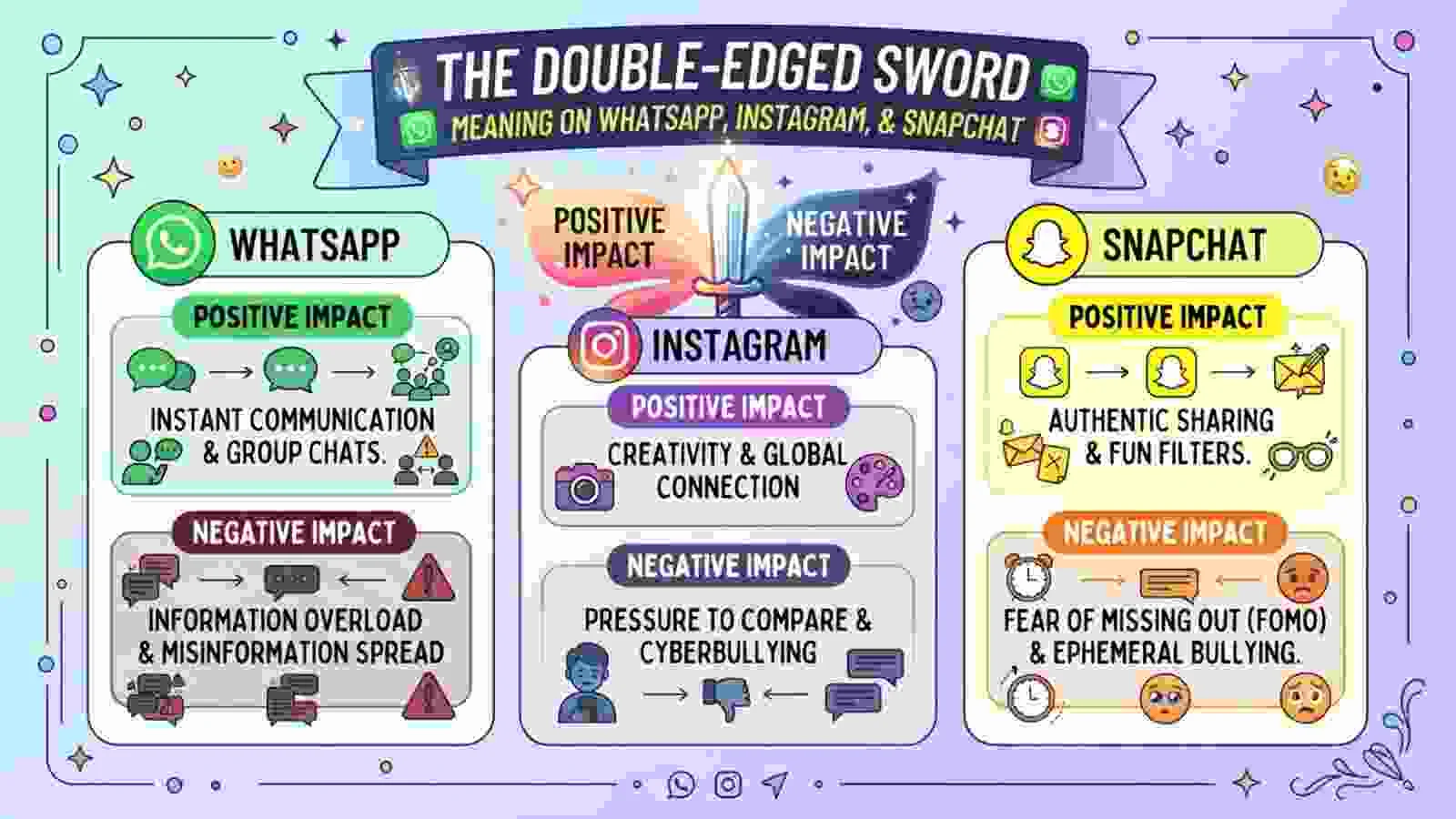
The meaning does not change across these platforms. It still refers to something with both positive and negative effects.
On WhatsApp
People may use the phrase in private chats or group discussions.
Example: “Group chats are a double edged sword. They keep us updated, but the messages never stop!”
On Instagram
People may use it in captions, comments, or direct messages.
Example: “Being an influencer is a double edged sword. You gain followers, but you may lose privacy.”
On Snapchat
Friends may use the phrase when talking about relationships, streaks, or online habits.
Example: “Snapchat streaks are a double edged sword. They’re fun, but they can feel like a daily task.”
The phrase is not specific to any app. It is a common English expression used online and offline.
Similar Slang Words and Phrases Like Double Edged Sword
Here are five related expressions that can help you talk about mixed results.
- Catch-22: A difficult situation where one problem makes another hard to solve.
- Mixed blessing: Something that brings both benefits and problems.
- Trade-off: A choice where gaining one thing means giving up another.
- Pros and cons: The good and bad points of something.
- Give and take: A situation where both sides make compromises or adjustments.
These phrases have similar uses, but their meanings are not exactly the same.
For example, a “mixed blessing” is very close to a double edged sword because both describe something with good and bad effects. A “trade-off” focuses more on what you gain and what you must give up.
FAQs About Double Edged Sword Meaning
1. Is double edged sword positive or negative?
It can be both. The phrase describes something with positive and negative effects. The exact meaning depends on the situation.
2. Is double edged sword slang?
No. It is an English idiom, not slang. People use it in casual chats, formal writing, and everyday speech.
3. Is it safe to use with elders?
Yes. It is a normal English expression. You can use it with elders, teachers, or coworkers when it fits the conversation.
4. Is double edged sword common in daily chat?
Yes, people use it in daily talks and online messages. However, it may sound more thoughtful or formal than simple phrases like “good and bad.”
5. What is an example of a double edged sword?
Social media is a good example. It helps people connect and learn, but it can also spread false information and waste time.
6. Does double edged sword mean something is dangerous?
Not always. It means something has both benefits and drawbacks. One of those drawbacks may be dangerous, but the phrase does not always refer to physical danger.
7. How do I use double edged sword in a sentence?
You can say, “Fame is a double edged sword because it brings success but reduces privacy.”
Conclusion
The phrase “double edged sword” means something that has both good and bad sides. It describes a situation, choice, or thing that can help you in one way but cause problems in another.
You may see it in text messages, social media posts, work talks, and everyday conversations. People often use it when discussing money, fame, technology, relationships, or success.
Now you know what the phrase means and how to use it in the right context. You can also reply with simple phrases like “That’s true” or “It depends on how you use it.”
Keep learning common English idioms and expressions to make your chats clearer and more natural.

William Bennett is a dedicated writer and language enthusiast who shares clear, helpful insights on word meanings, spelling, grammar, and everyday English.
As an author at MeaningZones.com, he aims to make confusing language topics simple, practical, and easy for readers to understand.