Have you ever shared an idea with a friend and wanted to give a clear example?
You may have heard someone say, “Case in point!” This phrase can sound strange if you have never heard it before. You may wonder what it means and how to use it.
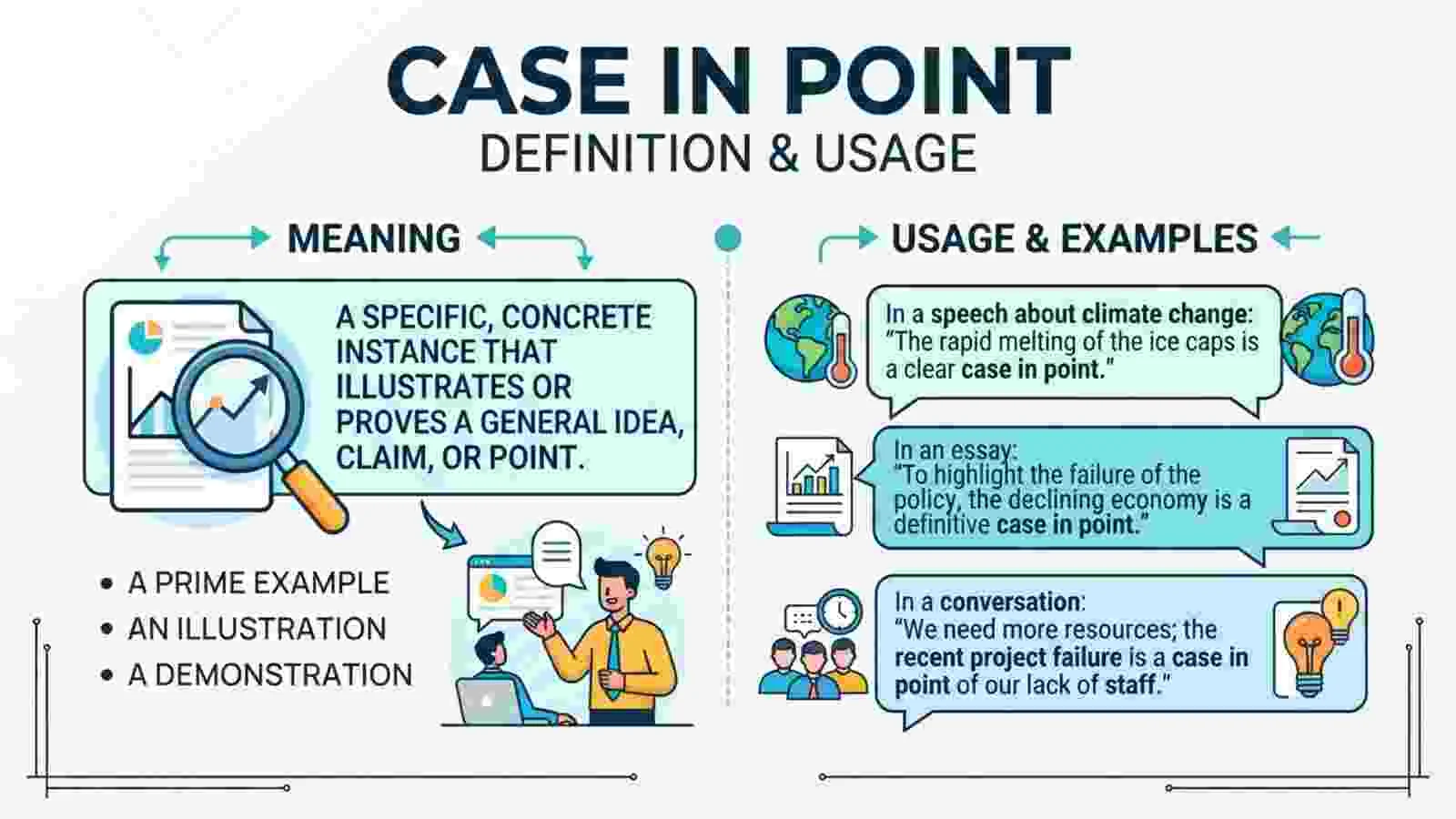
The phrase “case in point” means a clear example that proves or supports what someone is saying.
People use it in daily talks, text messages, and online posts. You may see it on WhatsApp, Instagram, or Snapchat when someone wants to make a point.
Learning this phrase can help you speak and write with more ease. It can also help you understand what others mean in a chat.
In this guide, you will learn its meaning, see simple examples, and find out how to use it the right way.
What Does “Case in Point” Mean in Text?
“Case in point” means a good example of something you have just said.
People use it to show that a fact or event supports their point.
For example:
“I said he was always late. Case in point, he missed the bus again.”
Here, missing the bus is an example that supports the claim that he is often late.
In simple words, it means:
- Here is a good example.
- This proves what I mean.
- This is a clear example of my point.
The phrase is common in spoken English and writing. It can also appear in text messages and social media posts.
Full Form of “Case in Point”
“Case in point” does not have a full form. It is not an acronym or a short form made from letters.
It is a common English phrase with its own meaning.
The word “case” means a situation or example. The words “in point” mean that the example fits the matter being discussed.
Together, the phrase means an example that clearly supports a point.
For example:
“Some dogs learn tricks very fast. Case in point, my dog learned to sit in one day.”
The dog’s quick learning is a clear example of the statement.
How Is “Case in Point” Used in Chat?
People use “case in point” when they want to support an idea with an example. It can make a message clearer and stronger.
Here are three simple chat examples.
Example 1: Talking about a late friend
Alex: “You are always late!”
Sam: “Case in point, I arrived 20 minutes late today.”
Sam uses the phrase to point to a clear example.
Example 2: Talking about good food
Mia: “This place has the best pizza.”
Noah: “Case in point, I already want another slice!”
Noah gives an example of how much he likes the pizza.
Example 3: Talking about a hard test
Lily: “That exam was so hard.”
Jake: “Case in point, half the class needed extra time.”
Jake shares an example that supports Lily’s view.
You can use this phrase at the start or in the middle of a sentence. It works best when the example clearly supports the point.
What Does “Case in Point” Mean From a Girl or Boy?
The phrase has the same basic meaning no matter who uses it. It means that something is a clear example of a point.
However, the tone may change based on the chat and the relationship.
When a girl says “case in point”
A girl may use it in a friendly, funny, or serious way.
Example:
Girl: “You always make me laugh. Case in point, I am laughing at your last message.”
She is giving an example of how funny she finds the other person.
In a serious chat, she may use it to support her view or explain why she thinks something is true.
When a boy says “case in point”
A boy may use the phrase in the same ways.
Example:
Boy: “You said this game was easy. Case in point, you lost three rounds in a row!”
He is using a funny example to support his claim.
Can it be flirty?
Yes, it can appear in a flirty chat, but the phrase itself is not romantic.
For example:
Person A: “You always know how to make me smile.”
Person B: “Case in point, look at this silly picture I sent you.”
The meaning comes from the full message, not just the phrase.
Is “Case in Point” Rude or Polite?
“Case in point” is usually a neutral phrase. It is not rude or offensive by itself.
People use it in both friendly and serious talks. But the example that follows can affect how the phrase sounds.
When it sounds polite
“You said the team works well together. Case in point, everyone helped finish the project.”
This is a positive example. It supports the idea that the team works well.
When it sounds rude
“You said you were good at cooking. Case in point, you burned the food again!”
This may sound rude because the speaker is making fun of someone.
How to use it kindly
- Give an example that fits your point.
- Avoid using it to shame someone.
- Think about the other person’s feelings.
- Use a friendly tone when joking.
The phrase is useful when you want to explain an idea. Just make sure your example does not hurt or insult someone.
When Should You Use “Case in Point”?
You can use this phrase in many everyday situations.
Use it when:
- You want to give a clear example.
- You want to support your opinion.
- You are talking with friends or family.
- You want to explain why something is true.
- You are writing a post or comment online.
- You are sharing a funny story that proves your point.
Example:
“Cats love warm places. Case in point, mine sleeps beside the heater every day.”
The cat’s habit supports the statement.
You can also use it in schoolwork, meetings, and other settings where examples help explain an idea.
When Should You NOT Use “Case in Point”?
Although the phrase is useful, it may not fit every situation.
Avoid it when:
- You are not giving a real example.
- Your message is very short and the phrase adds no value.
- You are writing to someone who may not know the expression.
- You want to avoid sounding sarcastic or judgmental.
- You need very simple wording for a formal notice.
- You are discussing a sensitive topic and the example may upset someone.
For example, saying “Case in point” without giving an example can leave the reader confused.
Instead of writing:
“Case in point!”
You could write:
“Here is a good example of what I mean.”
This version is simple and clear.
Best Replies to “Case in Point”
Your reply depends on what the other person is saying. Here are five short and natural responses.
- “Good example!” — Use this when the example supports their point.
- “That makes sense.” — Use this when you understand their idea.
- “True, I see your point.” — Use this when you agree.
- “Fair enough!” — Use this when their example seems reasonable.
- “I get what you mean.” — Use this when you understand their message.
Example chat
Friend: “You said I spend too much time gaming. Case in point, I played for six hours yesterday.”
You: “Fair enough! That is a lot of gaming.”
You can also disagree in a polite way.
Friend: “Case in point, everyone likes this movie.”
You: “Maybe, but I know a few people who don’t.”
Do not have to agree with every example. You can respond in a friendly way and share your own view.
“Case in Point” Meaning on WhatsApp, Instagram, and Snapchat
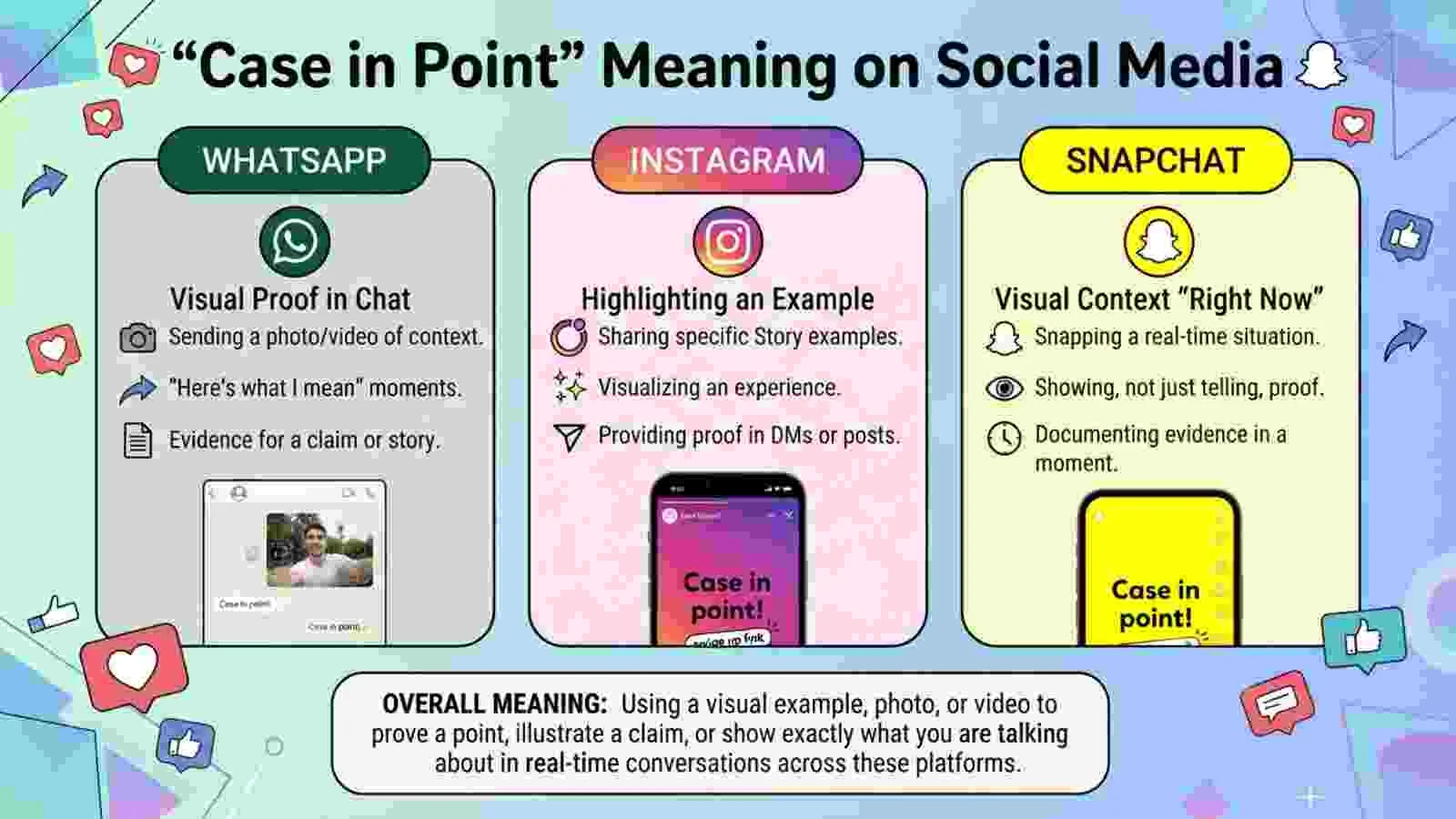
The phrase has the same basic meaning across these platforms. It means a clear example that supports a point.
Case in point on WhatsApp
On WhatsApp, people may use it in private chats or group conversations.
Example:
“Everyone in our group loves football. Case in point, we all watched the match last night.”
The match is an example of the group’s shared interest.
Case in point on Instagram
On Instagram, the phrase may appear in captions, comments, or replies.
Example:
“Small steps can lead to big changes. Case in point, my progress over the past six months.”
The progress supports the idea that small steps matter.
Case in point on Snapchat
On Snapchat, people may use the phrase in a quick message or story caption.
Example:
“I said my dog was playful. Case in point, he stole my sock again!”
The dog’s behavior gives a clear example.
The platform does not change the meaning. Only the topic and tone may change.
Similar Slang Words and Phrases Like “Case in Point”
Several English phrases have a meaning close to “case in point.” They can help you explain an idea or support your view.
- For example — Used to introduce an example that explains an idea.
- Proof of that — Used when something supports what you are saying.
- A perfect example — Used when an example clearly fits a point.
- Exhibit A — A playful way to present evidence or an example.
- Point proven — Used when an example or fact supports a claim.
Examples of similar phrases
For example: “I enjoy outdoor games. For example, I play football every weekend.”
Proof of that: “She works very hard. Proof of that, she finished the project early.”
A perfect example: “He is very kind. His help yesterday was a perfect example.”
Exhibit A: “You said you never eat sweets. Exhibit A: the empty candy box.”
Point proven: “You said the road was busy. Point proven, we waited 30 minutes in traffic.”
These phrases are not always exact replacements for “case in point.” Choose the one that best fits your sentence.
FAQs About “Case in Point”
1. Is “case in point” positive or negative?
It can be either. The phrase is neutral. The example that follows decides whether the message sounds positive, negative, or funny.
2. Is “case in point” slang?
No. It is a common English expression, not slang. People use it in everyday speech, writing, and online chats.
3. Is “case in point” common in daily chat?
Yes, people use it in daily talks and online messages. However, some people prefer simpler phrases such as “for example.”
4. Is it safe to use “case in point” with elders?
Yes. It is a normal English phrase and is generally polite. Still, use a respectful tone, especially when discussing a serious topic.
5. What is a simple synonym for “case in point”?
“For example” is a simple alternative. You can also say “a good example” or “proof of that,” depending on the sentence.
6. Can “case in point” be used in formal writing?
Yes. It can be used in essays, reports, and other formal writing when you want to introduce an example that supports your point.
7. What is the difference between “case in point” and “for example”?
Both introduce examples. “Case in point” often highlights an example that strongly supports a claim. “For example” is more general and can introduce almost any example.
Conclusion
The phrase “case in point” means a clear example that supports what you are saying. It is useful in daily talks, text messages, social media posts, and formal writing.
You can use it when you want to show that an idea is true or explain why you believe something. The phrase is not rude by itself, but your tone and example can change how it sounds.
Remember, “case in point” is not an acronym or a texting code. It is a common English expression. If you want a simpler option, you can say “for example” or “a good example.”
Now that you know the meaning, you can spot and use the phrase with more confidence. Keep learning common English expressions to make your chats and writing clearer.
Continue Reading:
- Beyond the Pale Meaning: Definition, Origin, and Examples ( for 2026)
- Vaya Con Dios Meaning: Translation, Origin, and Usage ( for 2026)
- Zero Sum Game Meaning: Origins, Examples, and Common Uses ( for 2026)

William Bennett is a dedicated writer and language enthusiast who shares clear, helpful insights on word meanings, spelling, grammar, and everyday English.
As an author at MeaningZones.com, he aims to make confusing language topics simple, practical, and easy for readers to understand.