Have you ever read a sentence like, “She went to work in spite of the rain,” and wondered what “in spite of” means?
You may see this phrase in texts, schoolwork, books, social media posts, or everyday conversations. It can look a little confusing at first.
The good news is that “in spite of” has a simple meaning. It means doing something even though there is a problem, difficulty, or reason not to do it.
You may see this phrase on WhatsApp, Instagram, Snapchat, or other online platforms. It is also common in everyday English.
In this guide, you will learn the in spite of meaning, how to use it, and how it differs from similar phrases. You will also see easy examples that can help you use it correctly.
What Does “In Spite of” Mean in Text?
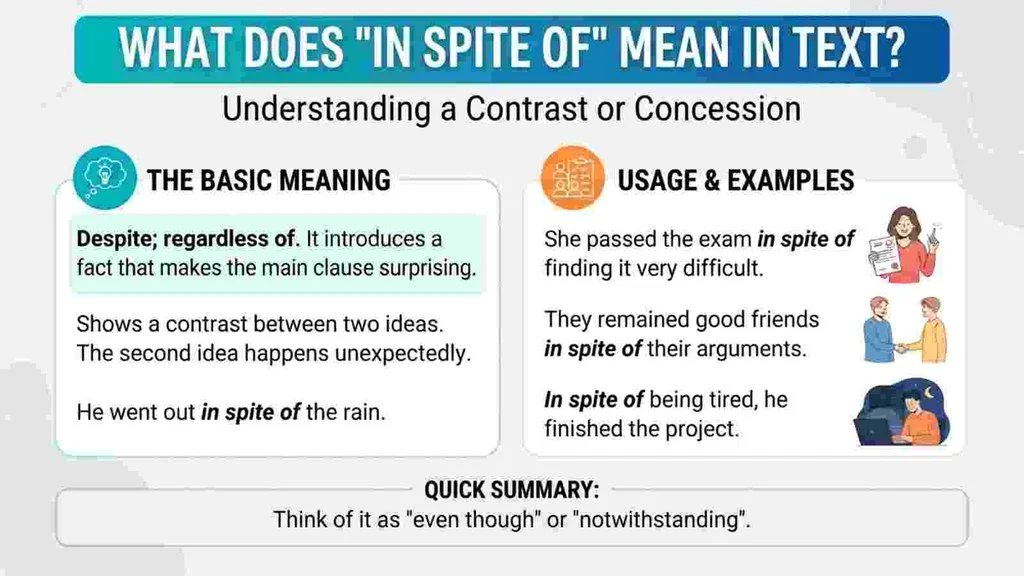
“In spite of” means “even though something happened” or “despite a problem.”
It shows that something happened even when there was a reason that could have stopped it.
Simple example:
“I went outside in spite of the rain.”
This means:
“I went outside even though it was raining.”
Another example is:
“She smiled in spite of her problems.”
This means she smiled even though she had problems.
In spite of is not really slang. It is a common English phrase. You can use it in casual chats, formal writing, schoolwork, and everyday speech.
Full Form of “In Spite of”
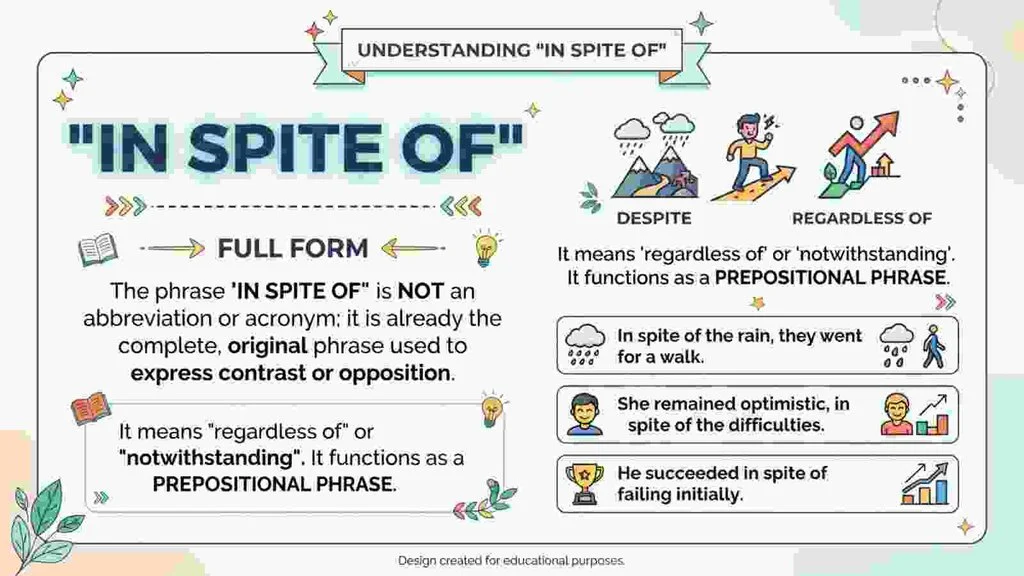
“In spite of” does not have a full form.
It is a phrase, not an abbreviation or acronym.
The phrase has the same basic meaning as “despite.”
For example:
- “He won in spite of the pressure.”
- “He won despite the pressure.”
Both sentences have almost the same meaning.
The main difference is the grammar and style used around them.
How Is “In Spite of” Used in Chat?

People can use “in spite of” in normal conversations when they want to show that something happened despite a problem.
Example 1
Alex: Are you still going to the party?
Sam: Yes, in spite of the rain.
Sam means that the rain will not stop him from going.
Example 2
Mia: How did you finish the project so quickly?
Liam: I finished it in spite of being tired.
Liam was tired, but he still finished the project.
Example 3
Emma: Did you enjoy the trip?
Noah: Yes, in spite of the bad weather.
The bad weather made the trip harder, but Noah still enjoyed it.
In casual texting, people may use simpler words instead.
For example:
“I went anyway, even though it was raining.”
This has a similar meaning and may sound more natural in very casual chat.
What Does “In Spite of” Mean From a Girl or Boy?
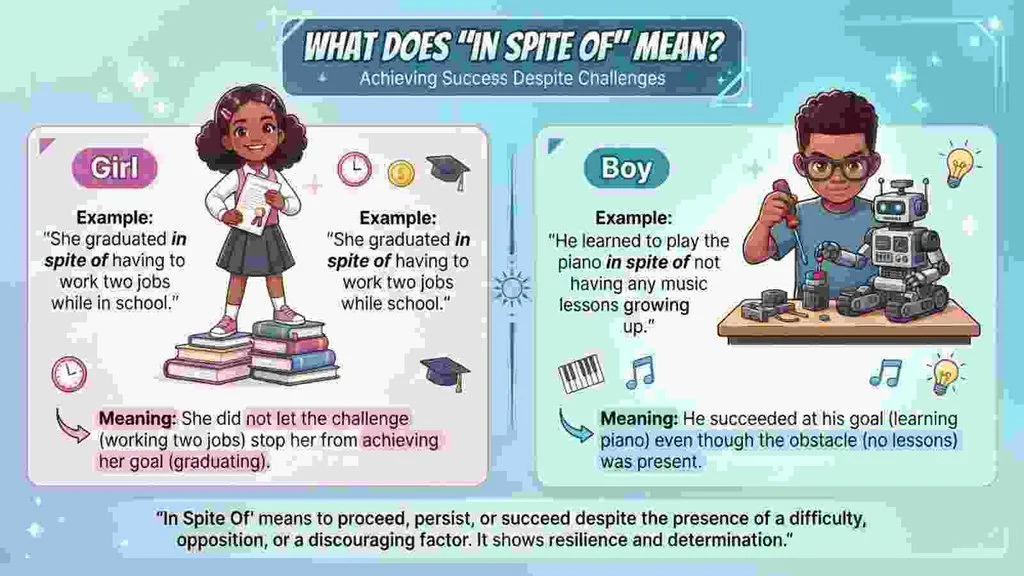
“In spite of” does not have a special meaning when a girl or boy uses it.
Unlike some slang terms, this phrase does not usually show a hidden romantic message.
The meaning depends on the sentence.
For example:
“I stayed with you in spite of everything.”
This could sound emotional or serious. But the phrase itself is not flirty.
Another example:
“He came to see me in spite of being busy.”
This simply means he came even though he was busy.
From a girl
If a girl says:
“I helped you in spite of everything.”
She may be showing that she helped someone even after facing problems.
From a boy
If a boy says:
“I went there in spite of the weather.”
He is simply saying that the weather did not stop him.
The emotional meaning comes from the whole sentence, not from “in spite of” itself.
Is “In Spite of” Rude or Polite?
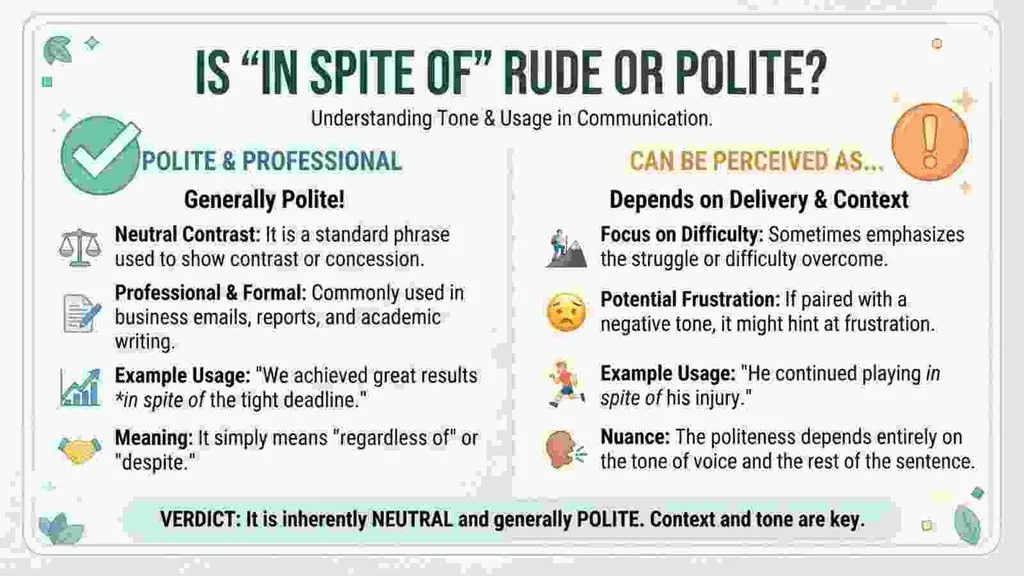
“In spite of” is neither rude nor offensive.
It is a normal English phrase. You can use it in both casual and formal situations.
For example:
“She kept working in spite of the difficulties.”
This sounds neutral and polite.
However, the sentence around it can sound negative or critical.
For example:
“He ignored my advice in spite of everything I told him.”
The phrase is not rude. The full sentence may sound frustrated.
So, tone depends on the message and situation.
When Should You Use “In Spite of”?
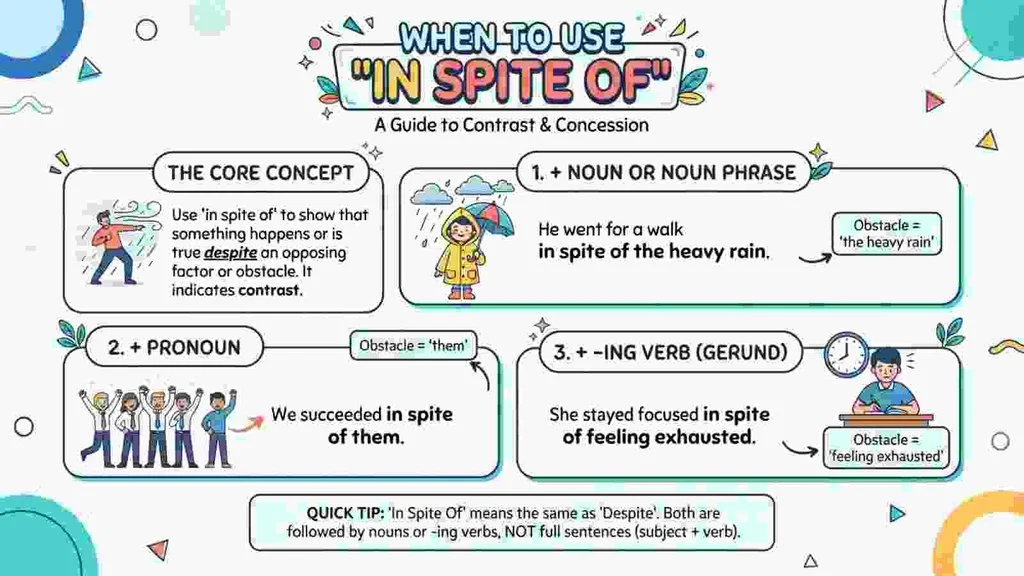
You can use “in spite of” when you want to show that something happened despite a problem or difficulty.
Use it:
- When talking about a difficult situation.
- When explaining why something was surprising.
- In everyday conversations.
- In school writing.
- In essays and articles.
- In formal or professional writing.
- When comparing a problem with an action or result.
Examples:
- “She passed the test in spite of being sick.”
- “We went out in spite of the cold weather.”
- “He kept trying in spite of his mistakes.”
- “They won the game in spite of the pressure.”
When Should You NOT Use “In Spite of”?
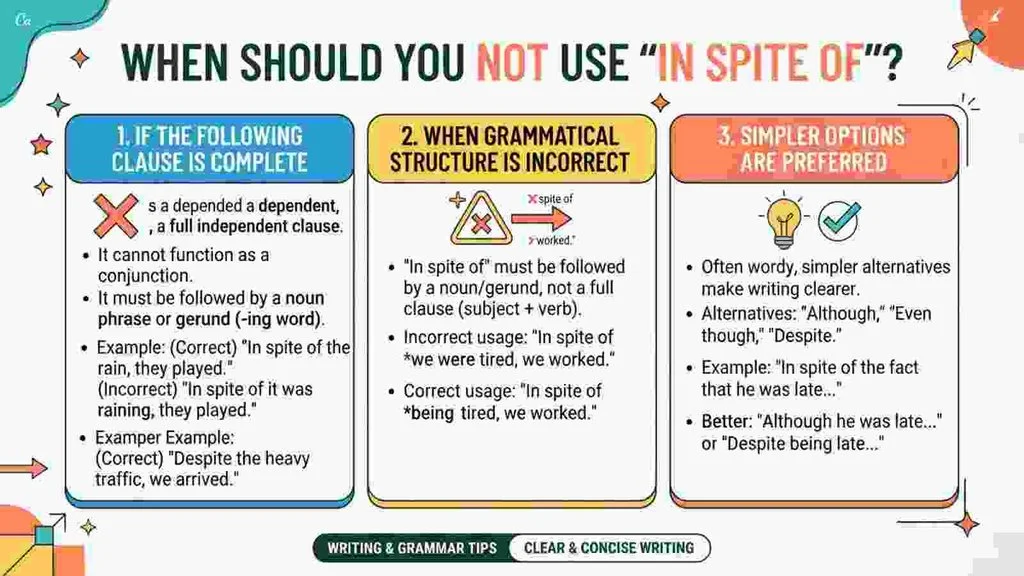
“In spite of” is grammatically correct, but it may not always be the best choice.
Avoid it when a shorter and clearer phrase works better.
For example, in a very quick text, you could say:
“I went anyway.”
Instead of:
“I went in spite of the problems.”
You may also want to avoid unclear sentences where the phrase does not connect properly to the next words.
Remember this useful rule:
In spite of + noun, pronoun, or verb ending in -ing
Examples:
- in spite of the rain
- in spite of the problem
- in spite of her fear
- in spite of being tired
- in spite of feeling sick
Do not normally use a complete clause directly after “in spite of.”
Incorrect:
“In spite of it was raining, we went out.”
Better:
“In spite of the rain, we went out.”
Or:
“In spite of the fact that it was raining, we went out.”
Best Replies to “In Spite of”
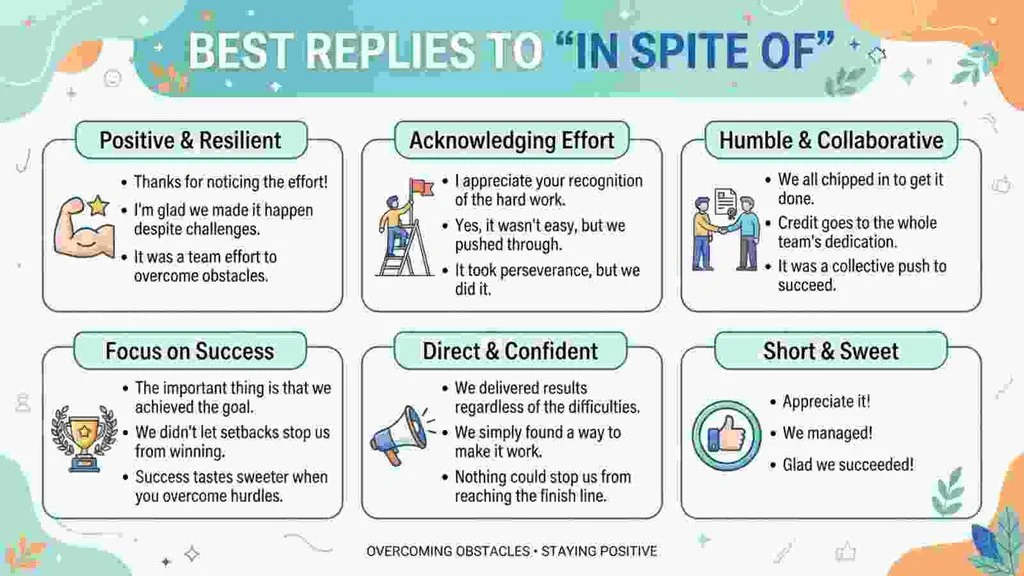
Since “in spite of” is a phrase rather than a question, there is no special reply.
Your response depends on what the person says.
Here are five natural replies:
- “That makes sense.”
- “I understand.”
- “Good for you!”
- “I would have done the same.”
- “That must have been difficult.”
Example:
Friend: “I went to work in spite of feeling sick.”
You: “That must have been difficult.”
Or:
Friend: “We had fun in spite of the rain.”
You: “Glad you still enjoyed it!”
“In Spite of” Meaning on WhatsApp, Instagram, and Snapchat
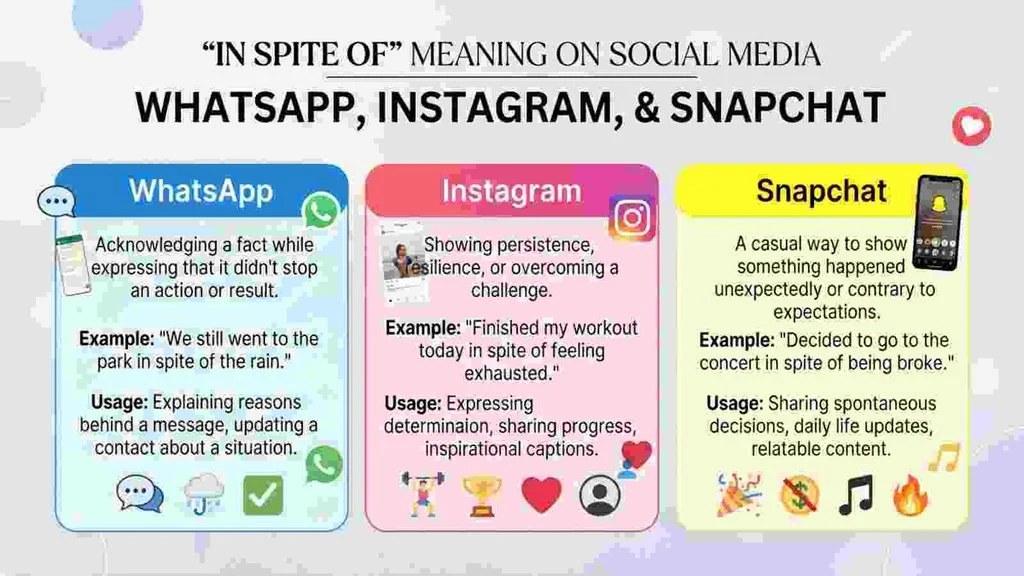
The meaning of “in spite of” stays the same on WhatsApp, Instagram, Snapchat, and other social platforms.
It does not become a special slang term on these apps.
“I went out in spite of the rain.”
It means the rain did not stop the person from going out.
A caption might say:
“Smiling in spite of everything.”
This means the person is staying positive despite problems.
Snapchat
Someone might write:
“We had fun in spite of the bad weather.”
Again, the meaning stays the same.
The platform does not change the meaning. The phrase simply shows that something happened despite a problem.
Similar Words and Phrases Like “In Spite of”
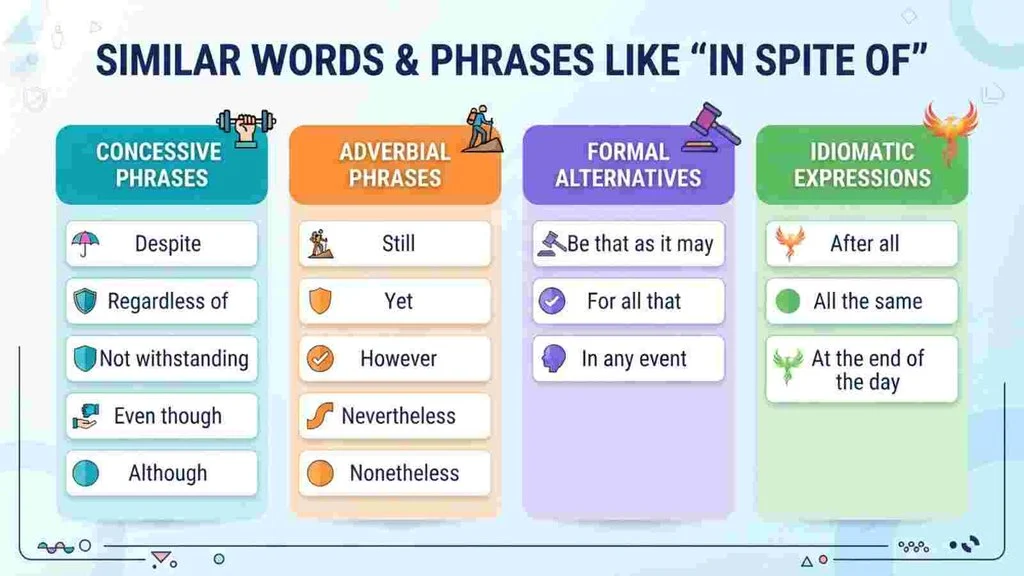
Several English expressions have a similar meaning.
1. Despite
“Despite” has almost the same meaning as “in spite of.”
Example:
“She went out despite the rain.”
2. Even though
“Even though” introduces a situation that contrasts with another action.
Example:
“She went out even though it was raining.”
3. Although
“Although” is often used to introduce a contrast.
Example:
“Although it was raining, she went out.”
4. Regardless of
“Regardless of” means something happens without being affected by another factor.
Example:
“We will continue regardless of the problems.”
5. Even with
“Even with” can show that something happened despite a difficulty.
Example:
“He succeeded even with very little experience.”
In Spite of vs. Despite
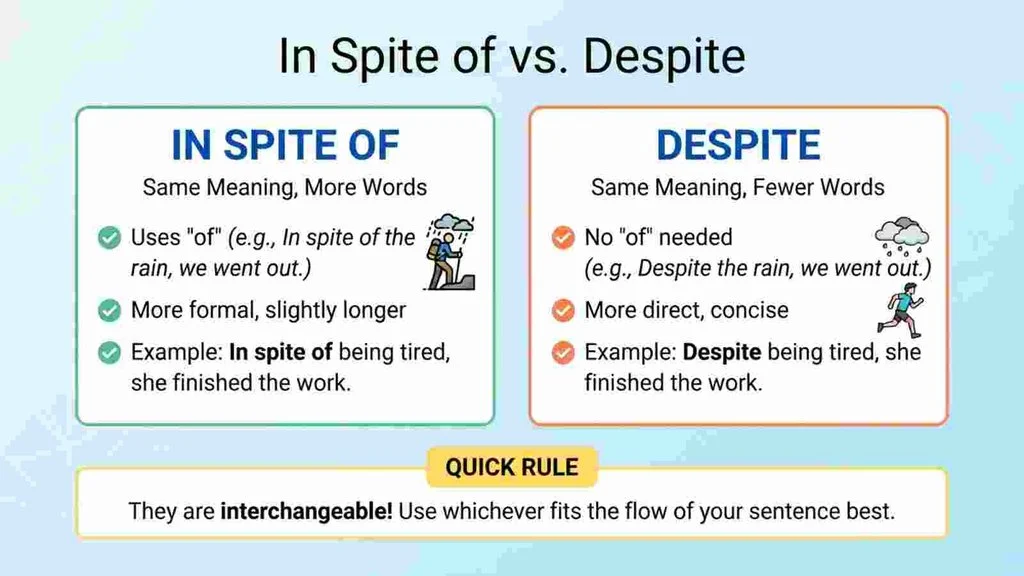
These two phrases are very close in meaning.
| Phrase | Meaning | Example |
| In spite of | Despite a problem or difficulty | She went out in spite of the rain. |
| Despite | Even with a problem | She went out despite the rain. |
| Even though | Shows a contrast | She went out even though it was raining. |
| Although | Shows a contrast | Although it was raining, she went out. |
| Regardless of | Without being affected by something | She went out regardless of the weather. |
Is “in spite of” the same as “despite”?
Yes, in most cases.
Compare:
“He won in spite of the pressure.”
and:
“He won despite the pressure.”
Both mean that he won even though there was pressure.
There is a small grammar difference in how these phrases are used, but their main meaning is almost the same.
FAQs About “In Spite of Meaning”
Is “in spite of” positive or negative?
It can be either. The phrase itself is neutral. It simply shows that something happened despite a problem or difficulty.
Is “in spite of” slang?
No. “In spite of” is a standard English phrase, not slang.
Is “in spite of” common in daily chat?
Yes. It is common in English, although people may use “even though” or “despite” more often in some conversations.
Is it safe to use “in spite of” with elders?
Yes. It is a polite and standard phrase. You can use it with friends, family, teachers, elders, and coworkers.
What is the difference between “in spite of” and “despite”?
They have almost the same meaning. Both show that something happened even though there was a problem.
Can I use “in spite of” in formal writing?
Yes. It is completely acceptable in formal writing, including essays, reports, and professional documents.
What comes after “in spite of”?
A noun, pronoun, or -ing form usually comes after it.
Examples:
- in spite of the rain
- in spite of his fear
- in spite of being tired
Conclusion
The in spite of meaning is simple: something happens even though there is a problem, difficulty, or reason that could stop it.
For example:
“She went outside in spite of the rain.”
This means she went outside even though it was raining.
“In spite of” is not slang. It is a common English phrase. You can use it in texts, conversations, schoolwork, social media posts, and professional writing.
It has almost the same meaning as “despite.” You can also use “even though” or “although” in many situations, but the grammar may change.
Now that you know the meaning, you can use “in spite of” with confidence. Understanding simple phrases like this can also help you read and write English more naturally.

Ella Peterson is an English language writer and grammar enthusiast at MeaningZones.com. She focuses on clear and practical English grammar, vocabulary, sentence structure, and everyday language usage.
Through easy-to-understand explanations and helpful examples, Ella helps readers improve their English writing and communication skills. Her goal is to make English grammar simple, useful, and accessible to everyone.