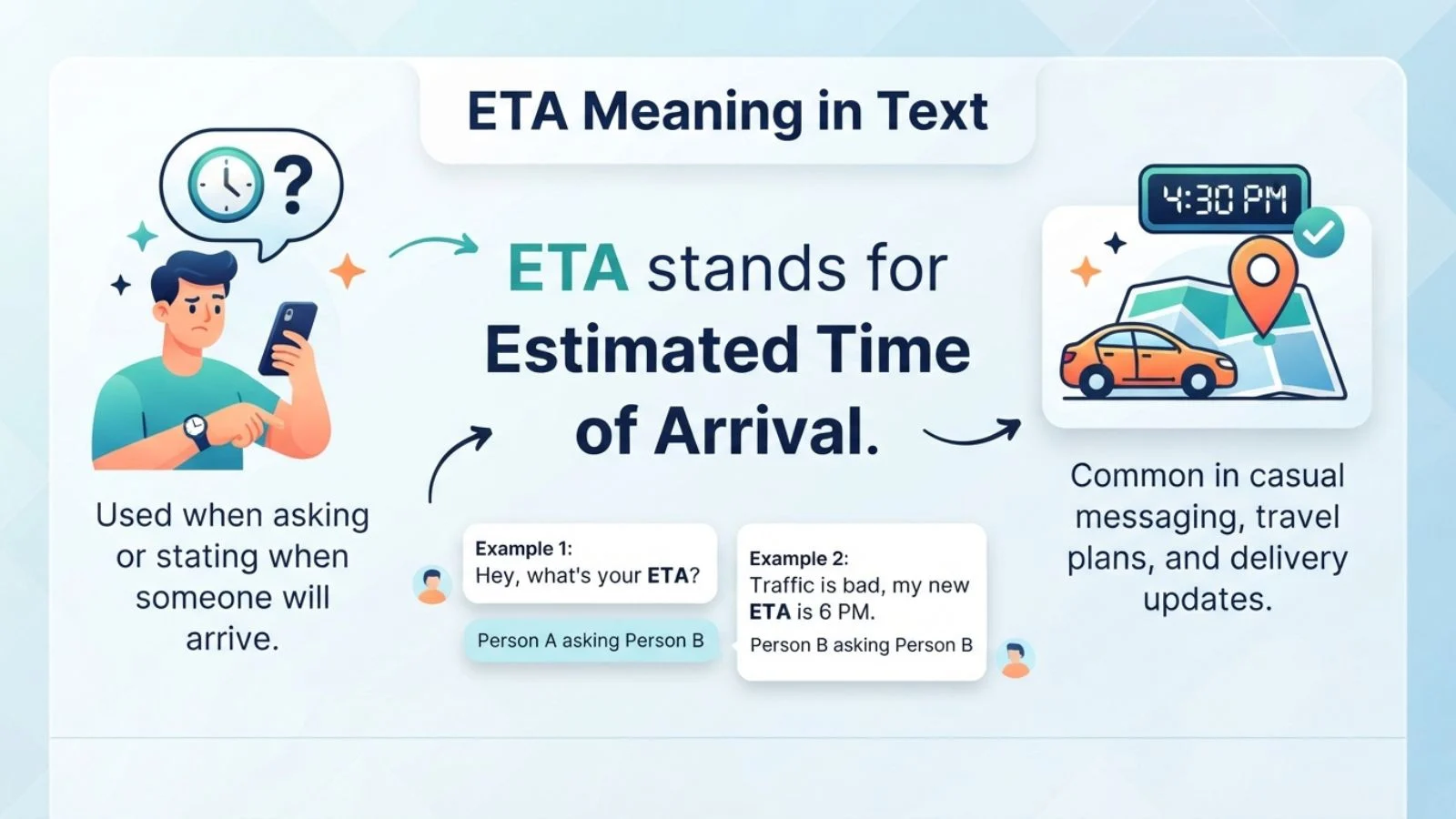
Ever wondered when someone will arrive, finish something, or get back to you? That’s where “ETA” can come in handy.
Hey, I want to share something that happened to me recently about ETA Meaning in Text.
I was chatting with a friend when I suddenly saw “ETA” pop up, and honestly, I had no clue what it meant at first.
I kept wondering, “Am I missing something here?” It was a bit confusing, and I didn’t want to respond the wrong way.
So, I decided to look into ETA Meaning in Text and understand its meaning and context.
I soon learned that ETA usually means “Estimated Time of Arrival.” People often use it when asking when someone or something is expected to arrive.
It can also be used more casually to ask when a person will finish or send something.
After understanding it, I realized how useful it is to know common texting terms.
Now, whenever I see ETA in a chat, text, or social media post, I know exactly what it means and how to respond.
Definition & Meaning of ETA
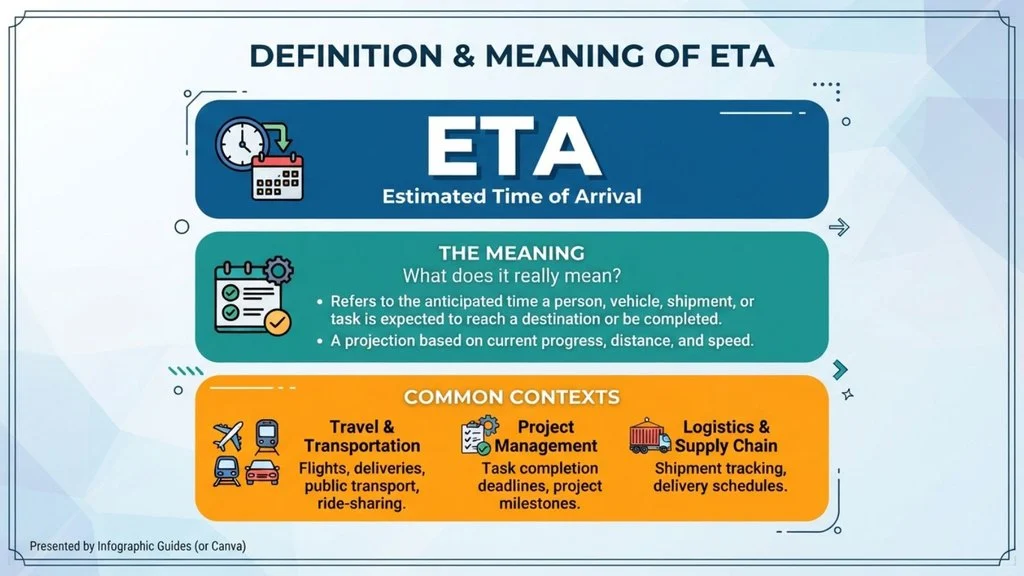
What Does ETA Stand For?
The most common ETA meaning in text is “Estimated Time of Arrival.”
ETA tells someone the expected time when a person, vehicle, package, delivery, or other thing will arrive.
For example:
Person 1: “Hey, where are you?”
Person 2: “I’m on my way. ETA 15 minutes.”
Here, the person expects to arrive in about 15 minutes.
ETA does not always mean an exact arrival time. The word “estimated” is important. Traffic, weather, delays, or other problems can change the actual arrival time.
Simple Examples of ETA
You may see ETA used like this:
“What’s your ETA?”
Meaning:
“When do you expect to arrive?”
Another example:
“My ETA is 7 PM.”
This means:
“I expect to arrive around 7 PM.”
You may also see:
“ETA on the food?”
This asks when the food is expected to arrive.
ETA in Text Messages
ETA is popular in texting because it saves time. Instead of typing:
“What time do you think you will arrive?”
Someone can simply write:
“What’s your ETA?”
This makes the term especially useful in short conversations.
ETA Can Also Mean “Edited to Add”
There is another meaning of ETA that appears mainly online:
ETA = Edited to Add
People sometimes use this when they edit an online post and add new information.
For example:
ETA: I found the answer. Thanks everyone!
Here, ETA does not refer to arrival. It means the writer added something to the original post.
However, when someone asks “What’s your ETA?” in a normal text conversation, they almost always mean Estimated Time of Arrival.
Background & History of ETA
Where Did ETA Come From?
ETA comes from the phrase “Estimated Time of Arrival.” It has long been used in transportation, travel, logistics, aviation, shipping, and military communication.
The abbreviation became useful because professionals often needed to communicate arrival information quickly.
For example, a transportation worker could say:
“The vehicle’s ETA is 10:30.”
This is much shorter than saying:
“The estimated time of arrival for the vehicle is 10:30.”
How ETA Became Common
As technology developed, ETA became common outside professional transportation.
People started using it when talking about:
- Cars
- Flights
- Trains
- Buses
- Food deliveries
- Packages
- Rideshares
- Friends arriving at a location
Mobile phones made ETA even more common.
Instead of calling someone and asking when they would arrive, people could simply send:
“ETA?”
The receiver immediately understands the question.
ETA in Modern Communication
Today, ETA is used in both casual and professional communication.
You might see it in a family group chat:
“What’s everyone’s ETA?”
You could see it at work:
“What’s the ETA for the report?”
You could also see it in a gaming chat:
“ETA to the next checkpoint?”
The exact meaning depends on the situation.
Usage of ETA in Various Contexts
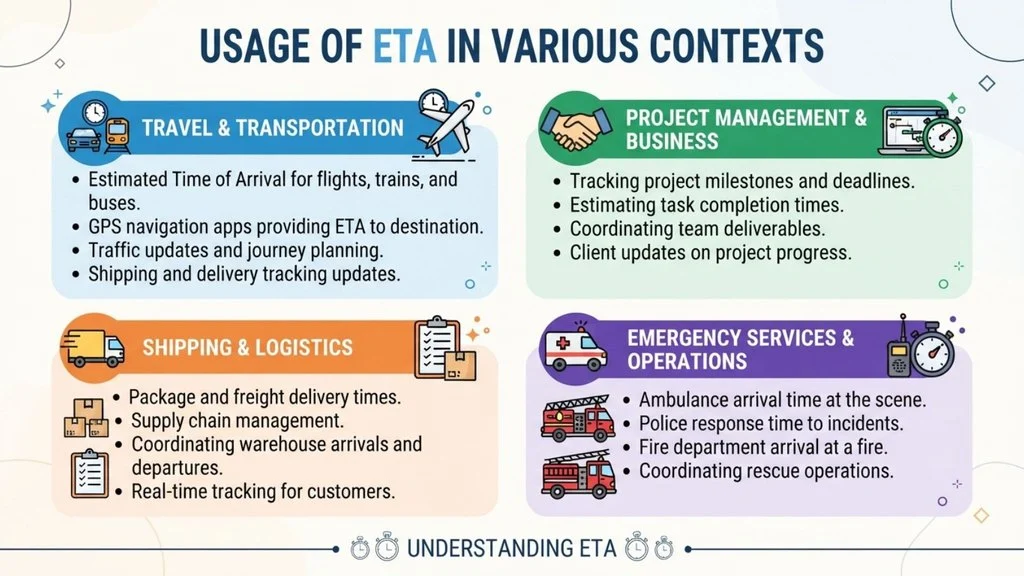
ETA in Texting
In everyday texting, ETA usually asks when someone will arrive.
Friend: “Are you close?”
You: “Yeah, ETA 10 mins.”
Another example:
Mom: “What’s your ETA?”
You: “Around 8:30.”
It is quick and easy to understand.
ETA on Social Media
People also use ETA on social media, especially when discussing updates.
For example:
“ETA on the new update?”
This can mean:
“When is the new update expected?”
However, on some forums, ETA can mean “Edited to Add.”
For example:
“ETA: I should have mentioned that this happened yesterday.”
Here, the writer is adding information after publishing the original post.
ETA in Gaming
Gamers may use ETA to ask how long it will take another player to reach a location.
Player 1: “Where are you?”
Player 2: “ETA 2 minutes.”
It can also refer to an expected game update:
“Any ETA for the patch?”
This means:
“Is there an expected time for the patch to be released?”
ETA in Casual Conversations
ETA is also common when making plans.
Friend: “What’s your ETA?”
You: “Probably 15 minutes.”
It can also be used for events:
“What’s the ETA for dinner?”
Depending on context, this may mean when dinner is expected to be ready or served.
ETA at Work
In professional communication, ETA can refer to expected completion time.
Manager: “What’s the ETA on the presentation?”
Employee: “I should have it ready by 3 PM.”
Here, ETA is often understood as expected completion time, even though the original phrase is “Estimated Time of Arrival.”
Common Misconceptions & Clarifications of ETA
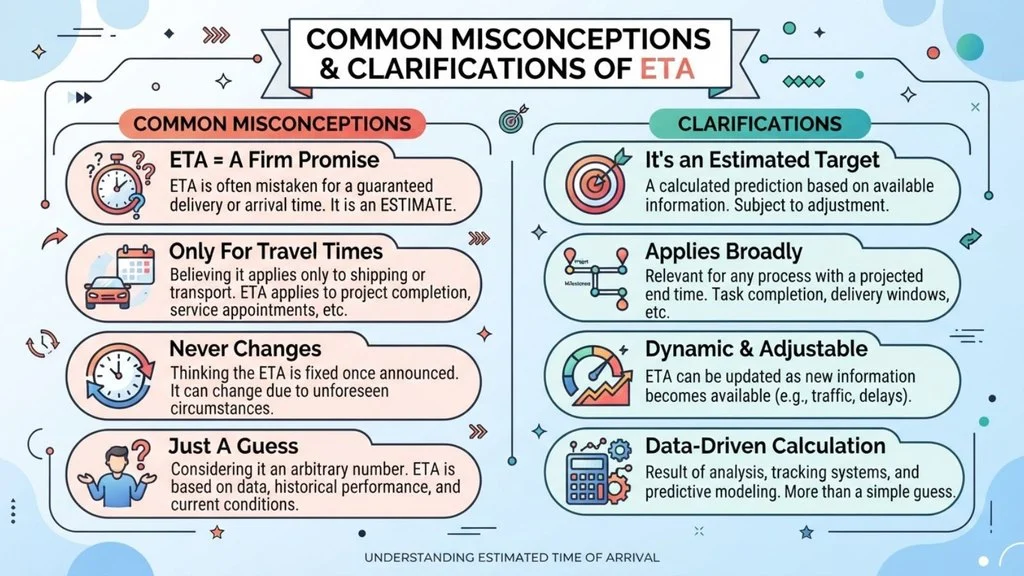
ETA Does Not Always Mean an Exact Time
One common mistake is assuming ETA is a guaranteed time.
If someone says:
“My ETA is 6 PM.”
They usually mean they expect to arrive around 6 PM.
They are not necessarily promising to arrive exactly at 6 PM.
Traffic, delays, weather, or unexpected events can change the arrival time.
ETA Can Have More Than One Meaning
The most common meaning is:
Estimated Time of Arrival
But in online communities, ETA can also mean:
Edited to Add
Context helps you determine which meaning is intended.
For example:
“What’s your ETA?”
Almost certainly means Estimated Time of Arrival.
But:
“ETA: I forgot to mention one thing.”
Usually means Edited to Add.
ETA Is Not the Same as “ASAP”
ETA and ASAP are sometimes confused.
ETA asks about an expected time.
ASAP means “As Soon As Possible.”
For example:
“What’s your ETA?”
asks when something is expected.
“Please send it ASAP.”
asks someone to do something as quickly as possible.
ETA Does Not Always Refer to People
ETA can refer to almost anything with an expected arrival or completion time.
For example:
- A person
- A package
- A taxi
- A flight
- A food order
- A software update
- A project
- A report
Similar Terms & Alternatives
There are several expressions that are similar to ETA.
| Term | Meaning | Common Use |
| ETA | Estimated Time of Arrival | Arrival or expected completion |
| ETD | Estimated Time of Departure | Leaving time |
| ASAP | As Soon As Possible | Urgent requests |
| EOD | End of Day | Workplace deadlines |
| Soon | In a short time | Casual conversations |
| When | Asking for a time | General communication |
| Deadline | Final expected time | Projects and work |
ETA vs. ETD
ETA means when someone or something is expected to arrive.
ETD means when someone or something is expected to leave.
For example:
ETA: 5:00 PM
ETD: 6:00 PM
ETA vs. ASAP
ETA gives an expected time.
ASAP shows urgency.
“What’s the ETA?”
means:
“When will it arrive?”
“Can you do it ASAP?”
means:
“Can you do it as quickly as possible?”
How to Respond to ETA
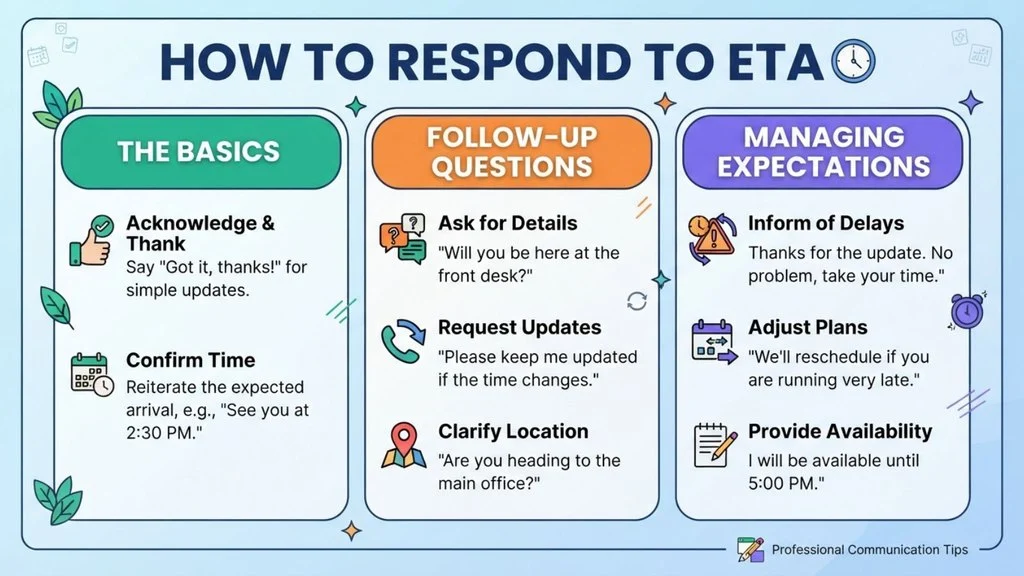
How you respond depends on the situation.
Casual Response
If a friend asks:
“What’s your ETA?”
You can say:
“About 10 minutes.”
Or:
“Around 7:30.”
Funny Response
With close friends, you can make your answer playful:
“ETA: whenever Google Maps stops judging me.”
Or:
“ETA: Five minutes… hopefully.”
Make sure the person understands that you are joking.
Professional Response
At work, give a clear and realistic estimate.
“My ETA is 2 PM. I’ll send the report as soon as it’s ready.”
Another option:
“The current ETA is Friday afternoon.”
This sounds clear and professional.
Privacy-Conscious Response
You do not always have to share your exact location or arrival time.
If someone asks and you are not comfortable giving details, you can say:
“I should be there soon. I’ll let you know when I’m close.”
This gives useful information without sharing unnecessary details.
Regional or Cultural Differences of ETA
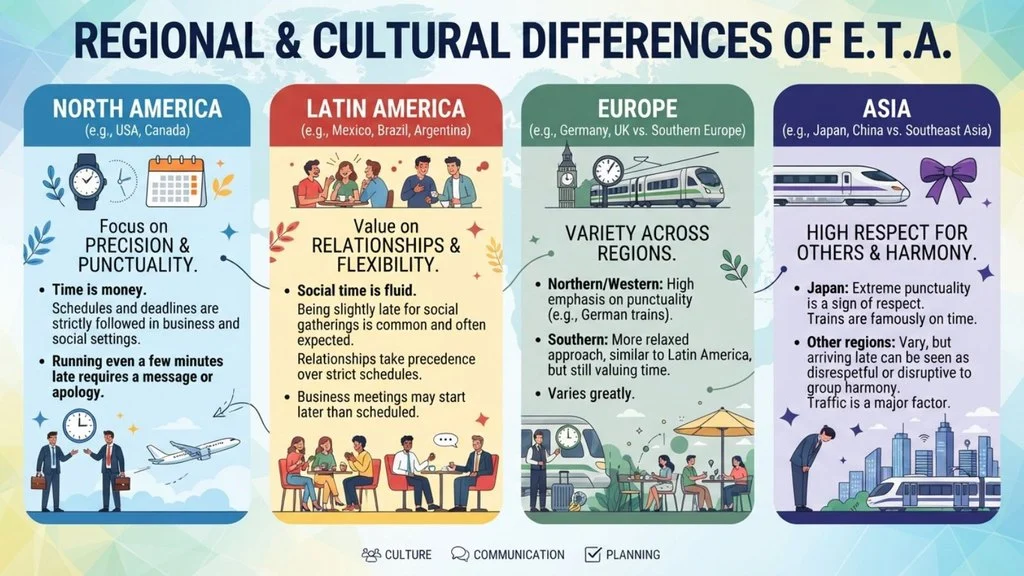
Is ETA Used Worldwide?
ETA is widely understood in English-speaking environments and in many international workplaces.
Because English is commonly used in technology, business, travel, and online communication, ETA has become familiar to people in many countries.
You may see ETA in:
- Pakistan
- India
- The United States
- Canada
- The United Kingdom
- Australia
- Singapore
- The Philippines
- Many international workplaces
ETA in Non-English Conversations
People who speak other languages may still use ETA when communicating online or at work.
For example, someone may speak another language but use:
“ETA 20 min”
because the abbreviation is short and widely understood.
However, local languages often have their own expressions for asking when someone will arrive.
Local Communication Styles
Some people prefer the full phrase:
“What time will you arrive?”
Others prefer:
“ETA?”
The choice often depends on age, workplace culture, platform, and familiarity with internet slang.
Comparison With Similar Terms of ETA
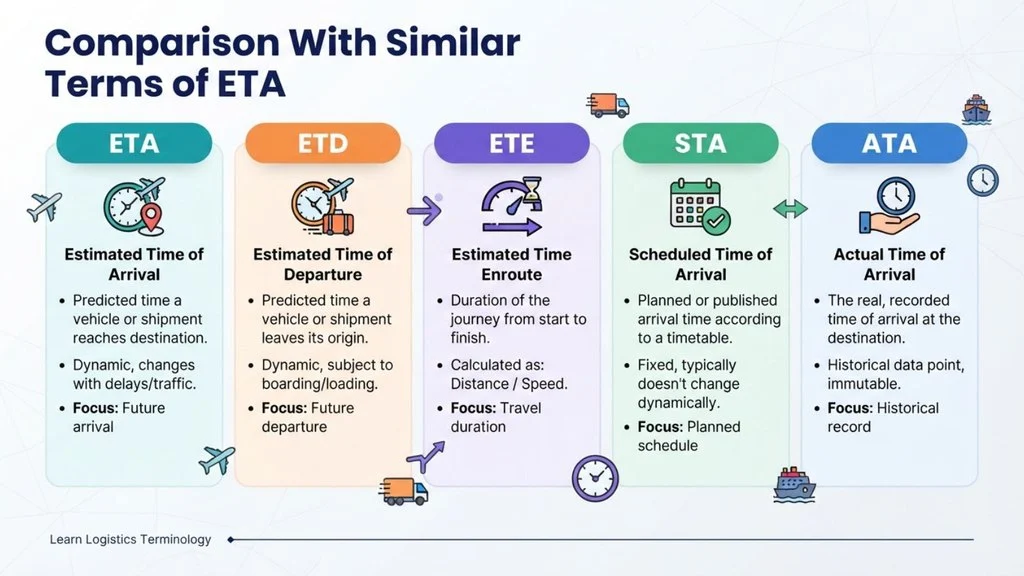
Understanding the difference between ETA and related expressions can help prevent confusion.
| Expression | Meaning | Example |
| ETA | Estimated arrival time | “What’s your ETA?” |
| ETD | Estimated departure time | “What’s the flight’s ETD?” |
| ASAP | As soon as possible | “Send it ASAP.” |
| EOD | End of the day | “I need it by EOD.” |
| TBD | To be decided | “The date is TBD.” |
| TBA | To be announced | “The venue is TBA.” |
| Soon | In a short time | “I’ll be there soon.” |
ETA vs. TBD
TBD means something has not been decided yet.
For example:
“Meeting time: TBD.”
ETA is different because it gives an expected time:
“ETA: 4 PM.”
ETA vs. TBA
TBA means To Be Announced.
For example:
“The release date is TBA.”
This means the date has not been announced.
Usage of ETA in Online Communities & Dating Apps
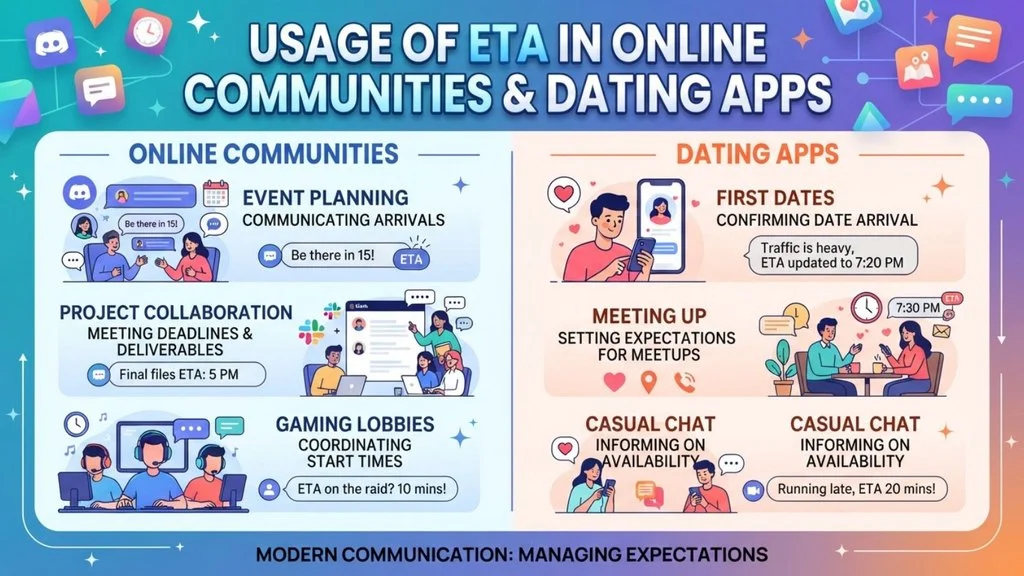
ETA on Social Platforms
ETA can appear in posts, comments, and discussions.
For example:
“ETA for the next update?”
This asks when something is expected.
On discussion forums, you may also see:
“ETA: I found another source.”
In this case, ETA means Edited to Add.
ETA on Dating Apps
On dating apps such as Tinder, people may use ETA when arranging a meeting.
For example:
Person A: “I’m leaving now.”
Person B: “Cool, what’s your ETA?”
The question simply asks when the person expects to arrive.
Another example:
“My ETA is about 15 minutes.”
ETA in Gaming Communities
Gamers often use ETA to coordinate movement.
Player 1: “ETA to the base?”
Player 2: “Two minutes.”
It can also be used for updates:
“Any ETA on the new season?”
Tips for Responding Online
When someone asks for your ETA, give a realistic answer.
Good:
“About 20 minutes.”
Better when there may be a delay:
“Around 20–30 minutes, depending on traffic.”
If you do not know:
“Not sure yet. I’ll update you when I know.”
Hidden or Offensive Meanings of ETA
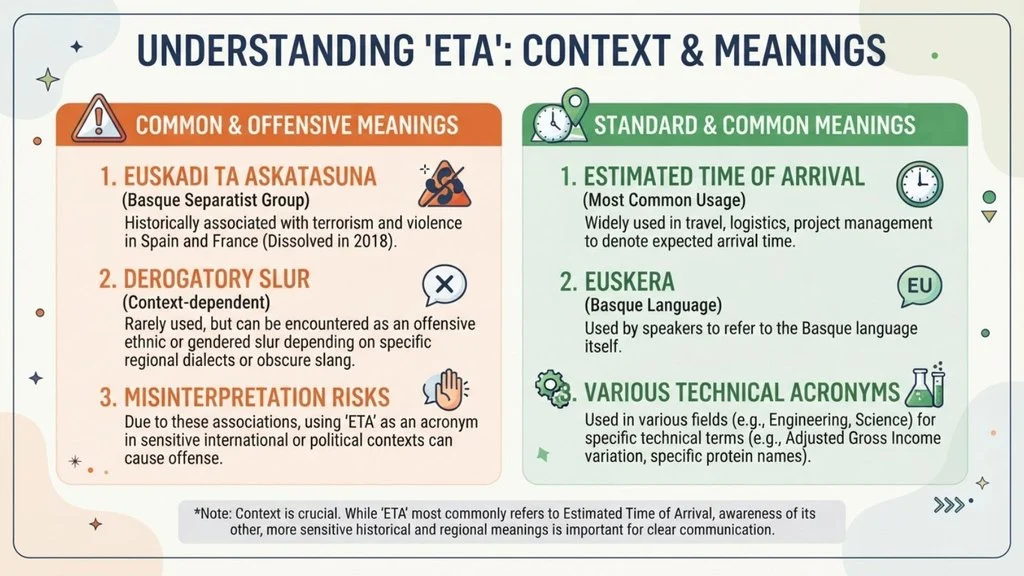
Does ETA Have an Offensive Meaning?
In normal texting, ETA is not an offensive term.
The most common meaning is simply:
Estimated Time of Arrival.
However, context always matters with abbreviations.
Some abbreviations can have different meanings in different communities. Therefore, you should not assume that every use of ETA means exactly the same thing.
ETA as “Edited to Add”
The alternative online meaning is not offensive either.
For example:
“ETA: I forgot to include the link.”
This simply tells readers that the writer edited the original message.
Why Context Matters
Look at the words around the abbreviation.
If someone says:
“What’s your ETA?”
They are asking about arrival.
If someone writes:
“ETA: One more thing…”
They probably mean Edited to Add.
When you are unsure, it is completely fine to ask:
“Do you mean estimated arrival time?”
This is better than guessing.
Suitability for Professional Communication of ETA
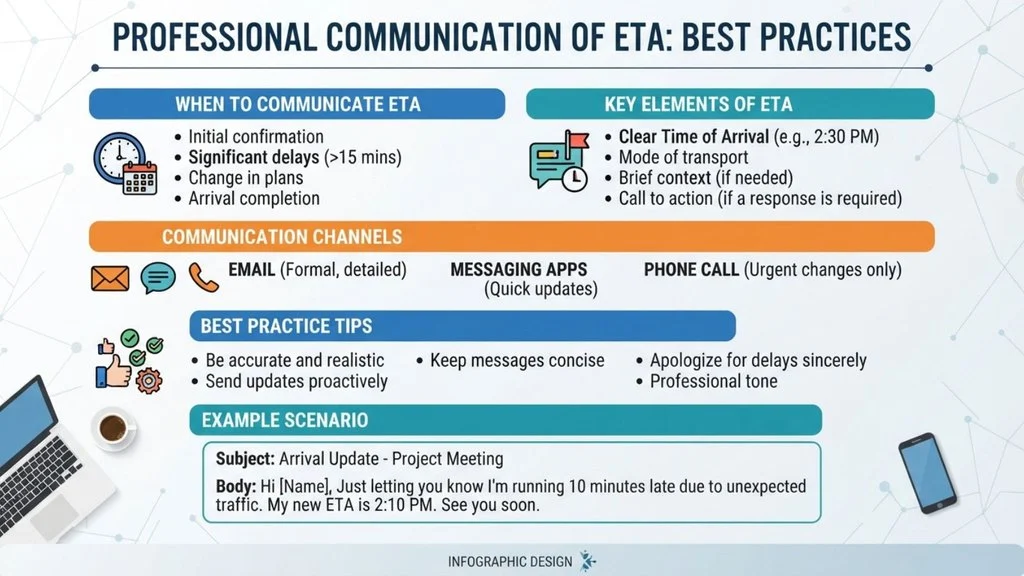
Can You Use ETA at Work?
Yes. ETA is widely used in professional communication, especially in workplaces involving projects, transportation, logistics, technology, customer service, and operations.
For example:
“What’s the ETA for the report?”
This is clear and common.
You could also write:
“The current ETA for completion is Friday.”
When to Use the Full Phrase
If you are writing a formal document for people who may not know the abbreviation, write the full phrase first:
Estimated Time of Arrival (ETA)
After that, you can use ETA.
For example:
“The Estimated Time of Arrival (ETA) for the shipment is 4 PM. The ETA may change due to traffic.”
Professional Alternatives
If you want to avoid abbreviations, you can say:
- “Expected arrival time”
- “Expected completion time”
- “When do you expect to arrive?”
- “When should we expect delivery?”
- “Expected delivery date”
For formal reports, these alternatives may be clearer.
FAQs About ETA Meaning in Text
1. What does ETA mean in text?
ETA usually means “Estimated Time of Arrival.” It is used to ask or give an expected arrival time.
2. What does “What’s your ETA?” mean?
“What’s your ETA?” means “When do you expect to arrive?”
For example:
“What’s your ETA?”
“Around 6 PM.”
3. Can ETA mean something other than Estimated Time of Arrival?
Yes. In online discussions, ETA can mean “Edited to Add.” Context usually makes the intended meaning clear.
4. Is ETA considered slang?
ETA is an abbreviation rather than traditional slang. It is widely used in both casual and professional communication.
5. Is ETA appropriate at work?
Yes. ETA is common in professional communication. However, when writing for a formal or unfamiliar audience, spelling out Estimated Time of Arrival may be clearer.
6. What is the difference between ETA and ASAP?
ETA refers to an expected time, while ASAP means as soon as possible.
“What’s the ETA?” = “When will it be ready?”
“Do it ASAP.” = “Do it as quickly as possible.”
7. What does ETA mean on Reddit or forums?
On forums and social platforms, ETA can mean either Estimated Time of Arrival or Edited to Add. Look at the context to determine which meaning is intended.
Conclusion
The most common ETA meaning in text is “Estimated Time of Arrival.” It is a simple abbreviation used to ask when someone or something is expected to arrive.
You may see ETA in text messages, social media, gaming chats, dating apps, delivery updates, travel conversations, and professional communication. For example, when someone asks “What’s your ETA?”, they usually want to know when you expect to arrive.
ETA can also mean “Edited to Add” in online discussions. This second meaning is less common in everyday texting, so context is important.
The good news is that ETA is easy to understand once you know what it means. When someone asks for your ETA, you can simply provide an estimated time, such as “20 minutes” or “around 7 PM.”
Whether you are chatting with friends or communicating at work, knowing common abbreviations like ETA can make online conversations faster, clearer, and easier to understand.
Continue Reading:
- FW Meaning in Text: Definition, Uses, and Examples (for 2026)
- IG Meaning in Texting: Definition, Examples, and Uses (for 2026)
- SMH Meaning in Texting: Meaning, Usage, and Examples (for 2026)

William Bennett is a dedicated writer and language enthusiast who shares clear, helpful insights on word meanings, spelling, grammar, and everyday English.
As an author at MeaningZones.com, he aims to make confusing language topics simple, practical, and easy for readers to understand.






4 thoughts on “ETA in Text: Meaning, Examples, and Common Uses (for 2026)”